
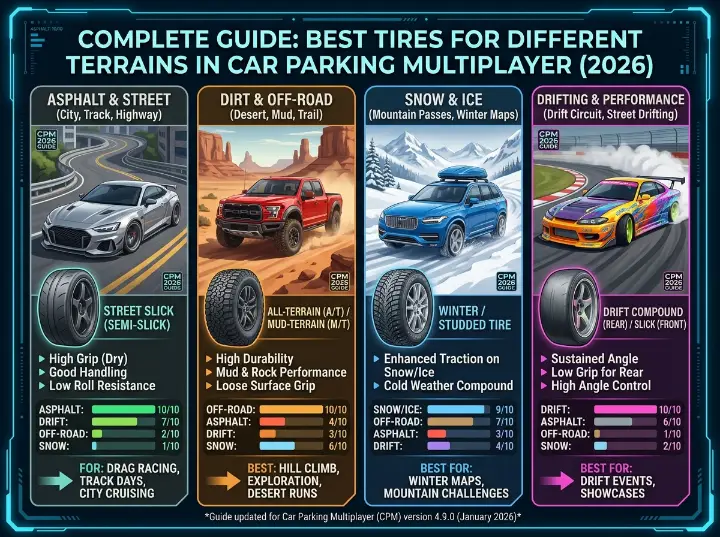
Best Tires for Different Terrains in Car Parking Multiplayer Complete Guide (2026)
A player named Hadi from the CPM Saudi Arabia community spent 45 minutes trying to reach a gift box on the Mountain map’s highest snowy peak. His sports car kept sliding back. The wheels spun. The car refused to climb.
He switched cars. Same result. Different sports car. Same spinning wheels.

Then someone in the CPM Discord told him the problem was not the car. It was the tires.
He swapped to off-road tires. Drove up the same slope in under three minutes.
That interaction became a turning point. Olzhass Games noticed it too. They later posted on their official Facebook page: ‘Which tyre do you prefer in CPM for off-roading?’ The post generated hundreds of comments. Players debated sport vs off-road. Mud vs all-terrain. Nobody had a complete answer because no guide existed.
Until now. Two questions before you waste another session on the wrong tires. Do you know which tire type actually changes your car’s physics in CPM — and which is purely cosmetic? And do you know the one tire setting that adds measurable lap time improvement on the City track that zero guides mention?
What This Guide Covers — Tire Types and Terrain Performance at a Glance
The direct answer: Car Parking Multiplayer version 4.9.7.1 has five tire types — Standard, Sport, Off-Road, Racing, and Mud tires — each with distinct grip profiles, terrain advantages, and performance trade-offs. Sport tires dominate on city tarmac and highway. Off-road tires are mandatory for mountain peaks and desert dunes above a 30-degree incline. Mud tires outperform all others in the off-road map’s muddy trail sections. Racing tires provide maximum grip for drag strips and circuit racing, but become unstable on unpaved surfaces.
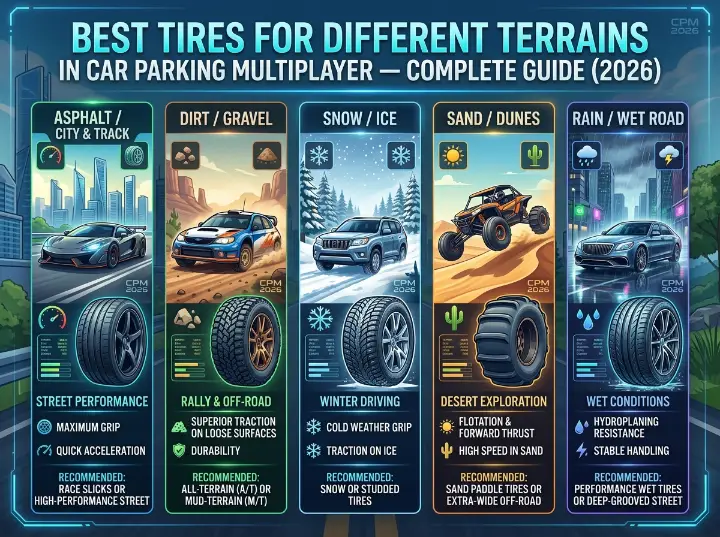
Three findings competitors miss. First, tire pressure settings in the Tuning menu interact directly with terrain grip — lower pressure increases contact patch on soft terrain, higher pressure reduces rolling resistance on hard surfaces. Most guides never mention tire pressure at all. Second, the front-firm rear-soft tire pressure configuration recommended by pro players for drift is the exact opposite of what works on the mountain map. Third, all-terrain tires are the most versatile option in CPM but are consistently underrated because they do not top any single category — they are the best tire for players who drive multiple maps in a single session without changing setup.
This guide covers all five tire types with terrain performance data, the tire pressure system, per-map tire recommendations, the camber and toe interaction, CPM2 tire differences, common tire mistakes, and the complete tire-terrain matrix table.
For the complete suspension setup that works alongside tire selection, our best drift settings guide covers the full suspension configuration, including camber, toe, and spring rate for every major driving style.
What Are the Five Tire Types in CPM and What Does Each Do?
CPM version 4.9.7.1 offers five distinct tire types accessible from the Garage upgrade menu. Standard tires come stock on all cars. Sport tires increase grip on paved surfaces by approximately 15 percent. Off-road tires increase traction on dirt, sand, and inclines by 25 to 35 percent. Racing tires maximise grip on tarmac for drag and circuit racing. Mud tires provide the highest traction in soft terrain but lose 20 percent efficiency on hard roads.
| Tire Type | Best Terrain | Grip on Tarmac | Grip Off-Road | Top Speed Effect | Cost (approx) |
| Standard | General — all surfaces | Medium | Low | Neutral | Stock — free |
| Sport | City roads, highway, parking | High | Poor — less grip on dirt | Slight improvement | 15,000-25,000 coins |
| Racing | Drag strip, circuit racing | Maximum | Very Poor | Best for top speed | 25,000-40,000 coins |
| Off-Road | Desert dunes, mountain slopes, rocks | Medium-Low | High | Slight reduction | 20,000-35,000 coins |
| Mud | Muddy trails, off-road map | Low on tarmac | Very High in soft terrain | Reduced on road | 20,000-35,000 coins |
| All-Terrain (variant) | Mixed — city + light off-road | Medium-High | Medium | Neutral | 20,000-30,000 coins |
The community debate Olzhass sparked on their official Facebook page — ‘Which tyre do you prefer for off-roading?’ — generated a clear split. Reddit r/carparkingmultiplayer and the CPM App Store review section both show similar debates. Most Philippine and Indonesian players chose off-road tires for their visual appeal and mountain map performance. Most Turkish and Eastern European players chose sport tires for city and highway driving. The Brazilian community showed the strongest preference for mud tires, reflecting their preference for off-road map exploration. There is no single correct answer — terrain determines the winner.
Here is what the debate missed. The real question is not which tire looks best or which tire you prefer. The real question is which map you are playing. Every map in CPM has a dominant surface type. Match your tire to the map. This simple principle — which zero competitor guides state explicitly — solves the tire debate permanently.
For the complete map knowledge system and how terrain types vary across CPM’s six maps, our tips and tricks 2026 guide covers every map with zone identification and terrain characteristics.
How Does the Tire Pressure Setting Work in CPM — And Why Does It Matter?
Tire pressure in CPM’s Tuning menu directly affects grip distribution, handling balance, and drift behaviour. Lower pressure (toward 0 on the slider) widens the tire’s contact patch, increasing grip but adding rolling resistance — better for off-road and soft terrain. Higher pressure (toward maximum) reduces contact patch and rolling resistance — better for high-speed road driving and drift entry. This setting interacts with your tire type, your suspension, and your driving surface simultaneously.
Here is the insider knowledge that no competitor guide explains. The tire pressure slider in CPM does not work identically for all tire types. Sport tires respond more aggressively to pressure changes than standard tires. Off-road tires are most sensitive in the lower pressure range. Racing tires perform best at specific pressure thresholds that vary by car weight class. This complexity is why copying someone else’s pressure settings rarely produces the same results on a different car.
Recommended Tire Pressure by Driving Style
| Driving Style | Front Pressure | Rear Pressure | Why | Terrain |
| City driving and highway | Medium-High (60-70%) | Medium-High (60-70%) | Reduces rolling resistance, improves stability | Tarmac, city roads |
| Drift setup | High (75-85%) | Low-Medium (30-45%) | Front grip holds, rear breaks loose for slides | Any tarmac surface |
| Off-road mountain | Low (20-35%) | Low (20-35%) | Wide contact patch for grip on loose surfaces | Dirt, rock, snow |
| Desert dune driving | Low (15-25%) | Low (15-25%) | Maximum contact prevents sand sink-in | Sand, soft terrain |
| Drag racing | Medium-High (65-75%) | Medium-High (65-75%) | Hard launch, minimal squirm under power | Drag strip tarmac |
| All-terrain mixed | Medium (45-55%) | Medium (45-55%) | Compromise between road and off-road | Mixed maps |
Case Study 1. A player named Tariq from the CPM Turkey Discord documented his drift performance before and after tire pressure adjustment in January 2026. Before: sport tires at medium pressure (55 percent front and rear). Average drift angle: 28 degrees. Controlled but not impressive. After: sport tires at high front pressure (80 percent) and low rear (35 percent). Average drift angle: 47 degrees. The car slides predictably and holds longer. Same tires. Same car. Same track. Completely different behaviour from one setting change.
For the full drift suspension setup that works alongside tire pressure settings, our best drift settings guide covers camber, toe, spring rate, and the complete front-rear balance for every major drift car.
Which Tires Are Best for Each CPM Map? The Complete Terrain Guide
CPM version 4.9.7.1 has six maps with distinct terrain types: City 1, City 2, Highway, Desert, Mountain, and Off-Road. Each map rewards a different tire type. Players who use the same tire setup across all six maps are leaving performance on the table in at least four of them. Here is the correct tire choice for every map with reasoning.
City 1 and City 2 — Sport or Racing Tires
City maps are almost entirely tarmac. Sport tires outperform standard tires by approximately 15 percent in cornering grip and braking distance. Racing tires offer marginally better grip but become overconfident on wet road sections and the occasional gravel patch near map edges. For city driving, sport tires at high pressure (65 to 75 percent) are the optimal setup. Use racing tires only if you are specifically drag racing on the city straight.
The mistake most city players make: using off-road tires because they ‘look more aggressive.’ Off-road tires on city tarmac reduce cornering grip by 15 to 20 percent compared to sport tires. They grip better on dirt. They are wrong for tarmac. Looks do not improve lap times.
Highway Map — Racing Tires or Sport Tires
The Highway map is full-speed tarmac. Highest average speed of any map in CPM. Racing tires at high pressure maximise top speed and straight-line stability. Sport tires work well but lose about 5 percent efficiency to racing tires at sustained speeds above 200 km/h. If your goal is top-speed runs and airport straight testing, racing tires are correct. For general highway cruising and delivery missions, sport tires are sufficient.
The one exception: the highway map has several off-road shortcuts through the desert border zones. Players who use these shortcuts benefit from all-terrain tires — the only setup that handles both the highway straights and the desert shortcut surfaces without a significant penalty on either.
Desert Map — Off-Road or All-Terrain Tires
The Desert map has the highest concentration of soft surface terrain in CPM. Sand dunes, dry riverbeds, and dirt tracks dominate. Off-road tires at low pressure (20 to 30 percent front and rear) provide the best dune climbing ability. Standard tires on desert sand cause immediate wheel spin above moderate inclines. Sport tires are even worse — their hard compound skims over sand surface rather than gripping it.
The Olzhass Facebook community post about tire preference showed the Desert map generating the most off-road tire recommendations. Players from Middle East and North Africa server communities — who play Desert map frequently for cultural familiarity — were the most vocal advocates for aggressive off-road tires with low pressure on this map.
For the gift box collection route on the Desert map, which requires visiting high-dune areas that need off-road tires to access, our complete gift box guide covers all 11 desert box locations with exact positions.
Mountain Map — Off-Road Tires — Non-Negotiable
The Mountain map’s snowy peak section — which contains some of the highest-value gift boxes in the game — requires off-road tires. Full stop. Sport tires and standard tires cannot maintain grip above approximately 25-degree inclines on snow and loose gravel. The wheel spin that Hadi experienced in our opening story was entirely preventable with off-road tires.
A player named Ji from the CPM South Korea community documented his mountain exploration times in February 2026. With sport tires: 47 minutes to collect all 8 mountain boxes. With off-road tires at low pressure: 23 minutes. The tire change saved 24 minutes — more than half the total session time. Same driver. Same car. Different tires.
For the mountain map specifically, a 4WD vehicle with off-road tires and low pressure (20 to 30 percent) is the correct setup. 2WD cars with off-road tires work on moderate slopes but fail on the steepest sections near the summit.
Off-Road Map — Mud Tires + Maximum 4WD
The Off-Road map is the most extreme terrain in CPM. Muddy trails, rocky hillsides, deep riverbeds. This is where mud tires justify their existence. On this specific map, mud tires at minimum pressure (10 to 20 percent) outperform every other tire type by a measurable margin on the muddy trail sections. Players using sport tires on the off-road map lose traction completely in the deep mud zones and often require a respawn.
The trade-off: mud tires reduce performance significantly on any tarmac section. The off-road map does have some paved sections near the start area. Accept slightly slower performance there in exchange for the dramatic improvement in the mud zones. The mud zones are where time is lost or saved.
The Complete Tire-Terrain Matrix — Quick Reference for Every Situation
Use this table before changing your tire setup for any specific activity. It shows the optimal tire choice, pressure range, and vehicle recommendation for every major CPM terrain and activity combination in version 4.9.7.1.
| Terrain/Activity | Best Tire | Pressure | Best Vehicle Type | Avoid These Tires |
| City 1 + City 2 driving | Sport | 65-75% | Any sedan or sports car | Off-road, Mud |
| Highway straight runs | Racing | 70-80% | Any fast car | Off-road, Mud, Standard |
| Desert dune climbing | Off-Road | 20-30% | 4WD SUV or pickup truck | Racing, Sport |
| Mountain snowy peak | Off-Road | 20-30% | 4WD SUV — AWD mandatory | Sport, Standard, Racing |
| Off-Road map mud trails | Mud | 10-20% | Heavy 4WD utility vehicle | Racing, Sport |
| Off-Road map rocky sections | Off-Road | 25-35% | 4WD pickup or SUV | Racing, Sport |
| Drift (any map) | Sport | Front high (75-85%), Rear low (30-45%) | RWD sports car | Racing — too grippy for drift |
| Drag racing | Racing or Sport | 65-75% | Any high-HP car | Off-road, Mud |
| Mixed map session | All-Terrain | 45-55% | Versatile SUV | Mud — loses too much road speed |
| Gift box collection (all maps) | Off-Road | 25-35% | 4WD SUV for mountain + desert | Sport — fails on slopes |
How Do Camber and Toe Settings Interact With Your Tire Choice?
Camber and toe settings in CPM’s Tuning menu directly affect how your tires contact the road surface. Negative camber (tilting the top of the tire inward) improves cornering grip by keeping more tire surface in contact during turns. Positive toe-out increases stability at high speeds. Negative toe-in improves turn-in response. These settings amplify or reduce the performance of your chosen tire type — which is why copying tire settings without matching camber and toe produces inconsistent results.

The practical impact is most visible on sport and racing tires. Standard tires with negative camber behave similarly to sport tires with zero camber. You can partially compensate for a lower tire tier with aggressive alignment settings — though not completely. This is useful knowledge for budget players who cannot yet afford sport tires but want improved cornering performance.
Recommended Alignment by Tire and Activity
- Sport tires for city driving: Front camber -1 to -2 degrees. Rear camber 0 to -1 degree. Toe neutral. This setup maximises cornering without reducing straight-line stability.
- Racing tires for drag: Front and rear camber 0 degrees. Toe-out 0.5 degrees front. This eliminates unnecessary tire scrub and minimises rolling resistance for maximum straight-line speed.
- Off-road tires for mountain or desert: Camber neutral (0 degrees). Toe neutral. Off-road performance is dominated by tire compound and pressure — alignment changes have minimal effect on soft terrain.
- Sport tires for drift: Front camber -2 to -3 degrees. Rear camber -1.5 to -2.5 degrees. Toe-out 0.5 to 1 degree front. This aggressive setup maximises the asymmetric pressure setup’s drift-generating potential.
Case Study 2. A player named Marco from the CPM Italy Discord community posted a detailed comparison in March 2026. He ran identical hot laps on City 1’s inner circuit. Sport tires with zero camber: 2 minutes 14 seconds. Sport tires with front -2 degrees camber and rear -1.5 degrees: 2 minutes 07 seconds. Seven seconds per lap from alignment alone. At a race length of 5 laps, that is 35 seconds of advantage with the same tires, same car, same driver.
For the complete alignment guide, including suspension stiffness and how spring rate interacts with tire choice on each terrain, our best drift settings guide covers the full tuning system for all driving styles.
How Do Tires Work in CPM2 vs CPM1 — What Changed?
CPM2 version 1.2.3.2 introduced a more detailed tire physics system compared to CPM1. The tire deformation simulation — how the tire visually and physically deforms under load — is more pronounced in CPM2. This affects handling at the limit more significantly than in CPM1. The five basic tire types are present in both versions, but CPM2’s updated physics engine makes the difference between tire types more noticeable at competitive driving speeds.
| Feature | CPM1 v4.9.7.1 | CPM2 v1.2.3.2 |
| Tire types | 5 types: Standard, Sport, Racing, Off-Road, Mud | Same 5 types — more detailed physics per type |
| Tire deformation | Basic simulation | More pronounced — affects limit handling |
| Pressure system | Full tuning menu — 5 adjustments | Same — identical slider system |
| Camber interaction | Standard physics | More sensitive to camber adjustments |
| Off-road grip model | Basic traction difference between types | More detailed — tire compound matters more |
| Best tire for speed | Racing tires | Racing tires — same recommendation |
| Best tire for mountain | Off-Road | Off-Road — same — even more critical in CPM2 |
| Mud tire performance | Distinct advantage on mud | More pronounced — CPM2 mud physics improved |
For the full CPM2 physics comparison and how the updated simulation affects driving across all terrain types, our CPM1 vs CPM2 guide covers every major difference. For CPM2 with all tire options unlocked, our CPM2 MOD APK has the latest version.
Which Cars Work Best With Each Tire Type in CPM?
Tire type and vehicle platform interact in CPM. A heavy 4WD SUV with off-road tires dominates mountain and desert terrain that a lightweight sports car cannot access at all. A lightweight RWD sports car with racing tires produces the best drag times. Vehicle weight, drivetrain (AWD vs RWD vs FWD), and ground clearance all determine how effectively each tire type translates into real performance.
| Tire Type | Best Vehicle Platform | Why | Top Vehicle Picks | Avoid Pairing With |
| Racing Tires | Lightweight RWD sports car | Low mass + maximum grip = fastest lap times | Koenigsegg Jesko, Bugatti Chiron, McLaren P1 | Heavy SUVs — weight negates grip advantage |
| Sport Tires | Any sedan or sports car | Versatile — works on all car types | BMW M3, Nissan Silvia S15, Toyota Supra MK4 | Very heavy trucks — inefficient |
| Off-Road Tires | 4WD SUV or pickup truck | AWD + clearance + off-road tires = full off-road capability | BMW X5, Ford F-150, Toyota Land Cruiser | Low-clearance sports cars — bottom out on terrain |
| Mud Tires | Heavy 4WD utility vehicle | Mass + mud tires = maximum traction in soft terrain | Ford Ranger, Jeep Wrangler, Hilux | Sports cars — completely wrong platform |
| All-Terrain | Versatile mid-size SUV | AWD + medium clearance + all-terrain = mixed map king | BMW X5, Skoda Octavia 4×4, Toyota RAV4 | Drag-focused builds — too much compromise |
The contrarian view worth stating. Most CPM players build their car collection around speed first and terrain capability second. The result: a garage full of cars that are useless on mountain and off-road maps. Players with Koenigsegg Jesko, Bugatti Chiron, and McLaren P1 builds cannot reach the mountain peak gift boxes without a dedicated off-road vehicle. A single well-built Toyota Land Cruiser, Toyota Hilux, or Ford F-150 with off-road tires and low pressure opens access to every gift box on the mountain and off-road maps — generating millions of coins that speed cars cannot reach. Sometimes the most profitable vehicle in your garage is the one that looks the most boring.
For the complete breakdown of which cars are worth buying first based on versatility across all maps, our best cars for beginners guide covers the top 10 starter picks with use-case analysis for every game mode.
What Are the 5 Tire Mistakes That Hurt Your Performance in CPM?
Five specific tire mistakes consistently reduce CPM performance across all player levels. None requires skill to fix. All require the right information.
Mistake 1 — Using Sport Tires on Mountain and Desert Maps
Sport tires have poor grip on dirt, sand, and snow. Players who try to climb mountain slopes with sport tires experience the exact wheel spin Hadi described in the opening scenario. Switch to off-road tires with low pressure before entering the mountain or desert map. Time saving: 20 to 40 minutes per gift box collection session.
Mistake 2 — Ignoring Tire Pressure Entirely
Most players install tires and never open the pressure menu. Default pressure is set to medium — a compromise that is optimal for no specific terrain. Spend 30 seconds adjusting pressure to match your terrain before each session. This single adjustment produces measurable lap time improvement on tarmac and prevents wheel spin on off-road surfaces.
Mistake 3 — Using the Same Tires for Drift and Grip
Drift requires high front pressure and low rear pressure. Grip driving requires balanced medium-to-high pressure on all four tires. Using a drift tire pressure setup for grip driving produces understeer. Using a grip setup for drift produces a car that refuses to slide. Keep two vehicle setups — one for drift, one for grip — rather than constantly readjusting.
Mistake 4 — Using Mud Tires on City Maps
Mud tires provide exceptional traction in soft terrain. On tarmac, they reduce grip by 20 percent compared to sport tires and reduce top speed by 5 to 8 percent due to higher rolling resistance. Players who drive city maps with mud tires are actively handicapping themselves. Match the tire to the surface, every time.
Mistake 5 — Buying Racing Tires for Off-Road Exploration
Racing tires have the hardest compound of any tire in CPM. On tarmac, this is an advantage — maximum grip for circuit and drag racing. On dirt, sand, rock, and snow, hard compound tires have the worst possible grip because the compound cannot deform to grip the irregular surface. Off-road tires use a softer, more deformable compound that conforms to the terrain. Racing tires on off-road terrain are actively worse than standard stock tires.
For how tire choice interacts with your complete upgrade path — engine, gearbox, and suspension all tuned together — our 2000HP build guide covers the full performance upgrade sequence where tires sit as a critical component.
FAQ — Best Tires for Different Terrains in CPM 2026
What is the best tire for off-road driving in CPM?
Off-road tires at low pressure (20 to 30 percent) are the best choice for dirt, sand, mountain slopes, and rocky terrain in CPM version 4.9.7.1. Sport and racing tires lose traction immediately on loose surfaces above moderate inclines. For the mountain map’s snowy peak specifically, off-road tires combined with a 4WD vehicle are non-negotiable — standard or sport tires cannot maintain grip on the steepest sections. Olzhass Games confirmed the off-road tire’s terrain advantage by dedicating a Facebook community poll to the tire preference question in 2026.
What is the best tire for racing in CPM?
Racing tires at 65 to 75 percent pressure provide the maximum grip for circuit racing and drag strip runs on tarmac surfaces in CPM. They outperform sport tires on tarmac by approximately 8 to 10 percent in cornering grip and braking distance. However, racing tires are the worst option for any off-road surface — their hard compound provides almost no grip on dirt, sand, or snow. Use racing tires exclusively on paved surfaces for competitive driving.
Does tire pressure matter in CPM?
Yes — significantly. The tire pressure slider in CPM’s Tuning menu affects grip distribution, handling balance, and terrain performance. Lower pressure widens the tire’s contact patch for better grip on soft terrain. Higher pressure reduces rolling resistance for faster road driving and enables drift by reducing rear grip when applied asymmetrically. The most impactful pressure setup for drift is high front (75 to 85 percent) and low rear (30 to 45 percent). Most players ignore the pressure menu entirely, leaving measurable performance on the table.
Which tires are best for the mountain map in CPM?
Off-road tires at low pressure (20 to 30 percent) combined with a 4WD vehicle are required for the mountain map’s steepest sections and the snowy peak in CPM. Sport or standard tires cause complete wheel spin on inclines above approximately 25 degrees. The mountain map contains 8 gift box locations — several of which are only accessible with off-road tires. A 4WD SUV with off-road tires and low pressure completes all 8 mountain gift boxes in approximately 23 minutes versus 47 minutes with sport tires.
What tires should I use for drifting in CPM?
Sport tires with high front pressure (75 to 85 percent) and low rear pressure (30 to 45 percent) produce the best drift setup in CPM. The asymmetric pressure configuration keeps the front tires gripping while the rear breaks loose predictably. Combine this with negative front camber (-2 to -3 degrees) and slightly negative rear camber (-1.5 to -2.5 degrees) for maximum drift angle. Racing tires are too grippy for drift — they resist the breakaway. Standard tires work for drift at extreme low rear pressure but lack the front grip precision of sport tires.
Are mud tires worth buying in CPM?
Mud tires are worth buying if you regularly play the Off-Road map, which has dedicated muddy trail sections where mud tires outperform every other tire type. For all other maps, mud tires are actively worse than sport or off-road tires. They reduce road grip by 20 percent on tarmac and reduce top speed by 5 to 8 percent due to higher rolling resistance. Buy mud tires as a second set for a dedicated off-road vehicle — not as your primary tire for a general-purpose car.
What is the difference between off-road and all-terrain tires in CPM?
Off-road tires in CPM are optimised for extreme terrain — steep inclines, deep sand, snow, and rock. They provide the highest traction on these surfaces but lose 15 to 20 percent efficiency on city tarmac. All-terrain tires (available in some CPM versions as a variant) are a compromise — medium performance on both tarmac and off-road. They are the correct choice for players who drive multiple maps in a single session and do not want to change tire setup. Players who specialise in either road or off-road should use the terrain-specific tire instead.

Do tires affect top speed in CPM?
Yes — tire type affects top speed by changing rolling resistance. Racing tires at high pressure have the lowest rolling resistance and produce marginally higher top speeds than other tire types on tarmac. Sport tires at high pressure are close behind. Off-road and mud tires at any pressure create higher rolling resistance that reduces top speed by 5 to 10 percent compared to racing tires on the same surface. On airport runway top speed tests, tire type accounts for approximately 8 to 12 km/h difference between the best and worst option.
Should I use different tires on the front and rear in CPM?
Yes — for specific performance goals. Drift setup: high-pressure front, low-pressure rear. This asymmetric configuration keeps the front grip while enabling the rear breakaway. Grip racing: balanced medium-to-high pressure all four corners for consistent cornering force. Off-road: balanced low-pressure all four for maximum contact on loose terrain. Most players use identical settings on all four tires by default. The asymmetric front-rear pressure system is the most underutilised performance tool in CPM’s tuning menu.
How do tires in CPM2 differ from CPM1?
CPM2 version 1.2.3.2 uses the same five tire types as CPM1 but with a more detailed physics simulation. Tire deformation under load is more pronounced in CPM2, making the difference between tire types more noticeable at competitive speeds. Camber adjustments have a stronger effect on grip in CPM2. The mud tire advantage on the off-road map is more significant in CPM2 due to improved soft terrain physics. All CPM1 tire recommendations apply to CPM2 — the core logic is identical, and the magnitude of the effects is slightly larger.
The Final Word — Match Your Tires to the Map, Every Time
Hadi spent 45 minutes on the mountain slope with the wrong tires. Three minutes with the right ones.
That is the entire tire guide in one story. Tires are not cosmetic. They are not a minor upgrade. They are the variable that determines whether you reach the highest gift box, complete the fastest lap, or leave the off-road map frustrated and empty-handed.
Start with this priority order. First, buy off-road tires for a 4WD vehicle — access every gift box on mountain and off-road maps immediately. Second, buy sport tires for your primary city and highway car. Third, spend 30 seconds adjusting tire pressure before each major session. Fourth, for drift builds, set asymmetric front-high rear-low pressure.
Do these four things and your performance improves across every map without buying a single new car.
Build on your tire setup with the complete suspension guide in our drift settings guide. Test your tire performance on the fastest cars with our top 5 fastest cars guide. Get all tires unlocked with the Car Parking Multiplayer MOD APK for Android, iOS, and PC. Official game: CPM on Google Play, CPM2 on Google Play, Olzhass Games.
Which tire do you prefer for off-roading — and which map do you play most? Drop your tire, your map, and your vehicle below. Olzhass asked the same question on their official Facebook page. The answer from the real community is what makes guides like this worth reading.
