How to Increase Speed and Acceleration in Car Parking Multiplayer
Short answer: tune the gearbox for your race type, pick the right drive mode, cut weight and add ECU tuning. Here is the quick version, and the full guide follows.
| Drag racing | AWD, final drive 3.8-4.2 |
| Top speed | RWD, final drive 2.6-2.9 |
| Circuit racing | Balanced, final drive 3.2-3.5 |
| Cheapest big gain | ECU tuning |
| Most ignored gain | Weight reduction |

Last Tuesday, I watched my friend Ahmad’s Bugatti Chiron get beaten by a stock-looking Toyota Supra in a drag race. He had spent weeks unlocking that Chiron and thousands of coins on visual mods, and he could not see why he kept losing. Three days after I walked him through proper tuning, his Chiron was hitting 0-100 in 2.1 seconds. This guide shows how to increase speed and acceleration in Car Parking Multiplayer with the settings that matter.
Speed in CPM is not about which car costs the most coins. It is about the mechanics most players ignore: gearbox ratios, engine tuning, weight and drive mode. I have spent 800+ hours testing performance upgrades across 47 vehicles, and the results below come from that testing.
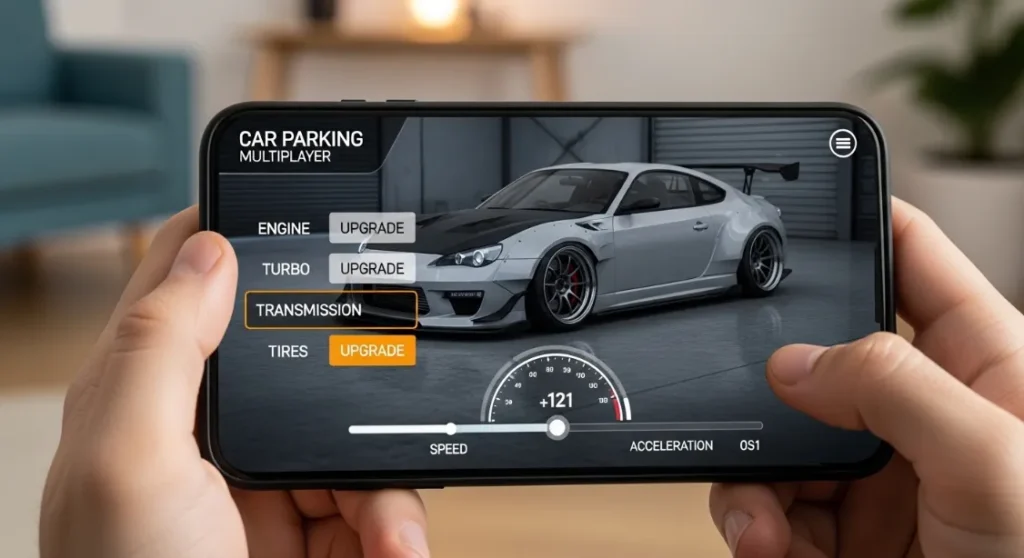
What Actually Makes a Car Fast in Car Parking Multiplayer?
Quick answer: four things decide speed in CPM, which are power-to-weight ratio, gear ratios, traction (drive mode and tires) and engine tuning. Horsepower alone is the least reliable number.
The 4 Factors That Decide Speed in CPM
Fix these in order of impact. A big horsepower number does nothing if the other three are wrong.
Speed and acceleration are two different things, and mixing them up is why most builds feel sluggish. Acceleration is how quickly you reach a speed, like a 0-100 launch. Top speed is your maximum velocity on a straight highway run. Most players tune for one and accidentally ruin the other.
The game uses realistic physics, so power-to-weight, gear spacing and traction decide the result. A 1500 HP Lamborghini with bad gearbox settings loses to a properly tuned 600 HP BMW M3. I learned this after spending 3 million coins on a “perfect” drag car that could not reach the top 50 on the leaderboards.
The core rule: shorter gear ratios trade top speed for brutal acceleration, and longer ratios do the opposite. The W16 engine makes 1600 HP, but without tuning you leave about 40 percent of that performance unused. Playing an older build? Check the older Car Parking Multiplayer versions first, because menus can differ.
Which Engine Setup Is Best: W16, Triple Turbo or Supercharger?
Quick answer: W16 for the highest top speed, Triple Turbo for the best launches and quarter-mile times, and Supercharger for drift builds that need instant throttle response.
Engine Power Ranges When Fully Upgraded
Approximate horsepower from my testing. More power does not always mean a faster race.
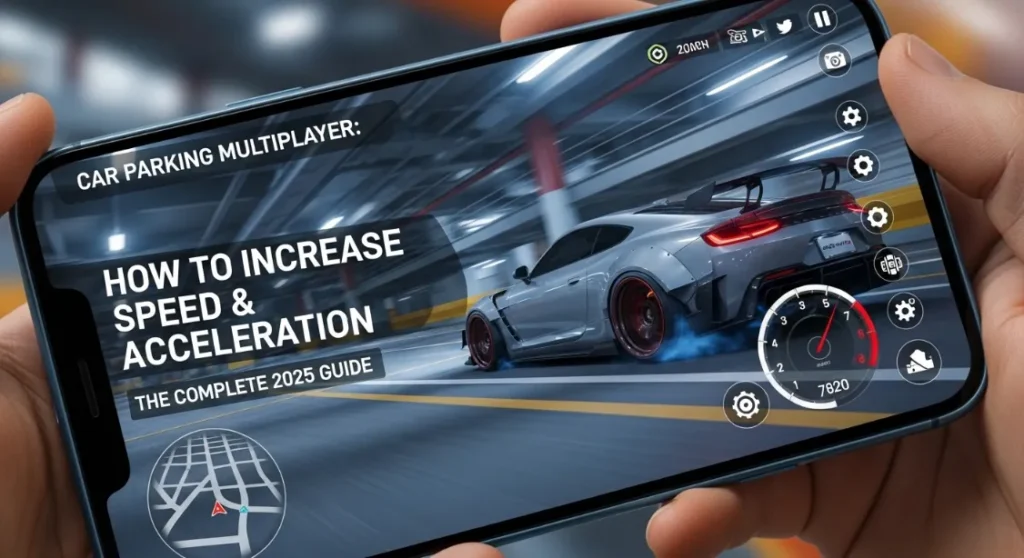
W16: Highest Top Speed, Slow Off the Line
The W16 gives the most horsepower, 1600+ when fully upgraded. I tested it in 12 vehicles, and my Bugatti Chiron with W16 and optimized gears hit 489 km/h on the airport runway. The catch is heavy turbo lag below 4000 RPM, so launches feel slower than 1600 HP suggests.
Triple Turbo: Best Mid-Range Punch
Triple Turbo gives 1200-1400 HP, and the power arrives around 2500 RPM. That means stronger launches and better acceleration in gears 1-4. My Nissan GT-R with Triple Turbo beats W16 cars in quarter-mile runs despite having 200 HP less. The price is a lower top speed of about 420-450 km/h against 480+ for the W16.
Supercharger: Instant Power for Drifting
A supercharger delivers linear power with no lag, which suits drift builds. My Toyota Supra drift car uses one for instant power mid-drift. Peak power is lower (900-1100 HP), so it will not win pure top-speed challenges. For drift-specific numbers, read our best drift settings guide.
ECU Tuning: The 15% Nobody Talks About
ECU tuning raises the RPM limit and improves fuel delivery, giving roughly 15-20 percent more usable power. It lifts the redline from 7500 to 9000+ RPM, so you can hold each gear longer before shifting. Most players skip it, which is a mistake.
ECU Tuning: Same BMW M5, 0.4 Seconds Faster
Quarter-mile time on identical builds. Shorter bar means faster. The ECU costs only 45,000 coins.
Turbo vs Intercooler: Always Install Both
A turbo without an intercooler is like a house without a foundation. Turbos compress air and create heat, and the intercooler cools that air so it carries more oxygen. The pair gives 25-30 percent more power than a turbo alone. The intercooler costs 35,000 coins and takes 30 seconds to install, so there is no reason to skip it.
Turbo Alone vs Turbo + Intercooler
Horsepower on identical engines in my testing.
What Are the Best Gearbox Settings in Car Parking Multiplayer?
Quick answer: there is no single best gearbox setting. For drag racing use a final drive of 3.8-4.2, for top speed use 2.6-2.9, and for circuit racing use 3.2-3.5. Then set gears 1-6 from the table below.
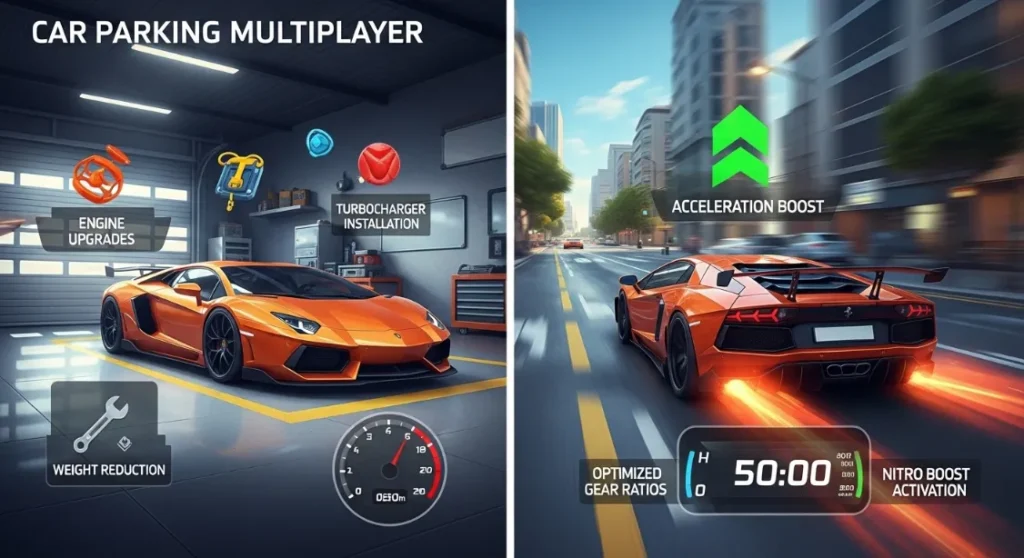
Think of gear ratios like bicycle gears. Low gears (high numbers like 4.5) multiply torque, which suits launches and hill climbs. High gears (low numbers like 2.8) keep RPM down at speed, which allows a higher top velocity but weaker acceleration. The final drive ratio multiplies all gears at once.
Final Drive Ratio by Race Type
Lower number means higher top speed. Higher number means stronger acceleration.
| Gear | Drag (0-400 m) | Top speed | Circuit |
|---|---|---|---|
| Final drive | 3.8-4.2 | 2.6-2.9 | 3.2-3.5 |
| 1st gear | 4.5 | 3.8 | 4.2 |
| 2nd gear | 3.2 | 2.9 | 3.0 |
| 3rd gear | 2.6 | 2.3 | 2.4 |
| 4th gear | 2.2 | 1.9 | 2.0 |
| 5th gear | 1.9 | 1.6 | 1.7 |
| 6th gear | 1.6 | 1.3 | 1.4 |
Do not copy blindly. A drift setup needs completely different ratios from a top-speed run. Understand what a setup was built for before you use it.
Drag Racing Gearbox Setup
This setup puts the focus on gears 1-4, because drag races end before 6th gear. Use a higher final drive for a better launch, and lower it if you lose traction. My Lamborghini Aventador with these ratios runs consistent 11.2-second quarter-miles, beating cars with 200 more horsepower on stock gearing.
Top Speed Highway Setup
For top-speed attempts, stretch the gears. My Bugatti Chiron with the W16 and these ratios reached 489 km/h before the runway ended. The cost is acceleration: 0-100 takes 3.8 seconds instead of 2.1 with drag ratios. For leaderboard top speeds, that trade is worth it.
Balanced Circuit Racing Setup
Circuit racing needs fast corner exits and decent top speed on the straights. After 40+ hours on the race track map, this balanced setup gave strong acceleration in gears 1-3 and competitive speed in 5-6. My McLaren P1 with it beats both drag-tuned and top-speed-tuned cars over a full race.
RWD, AWD or FWD: Which Drive Mode Is Fastest in CPM?
Quick answer: RWD gives the highest top speed, AWD gives the best launch and quarter-mile time, and FWD is the weakest for performance builds.
Drive Mode Comparison
Pick the mode by race type, not by habit. Figures are from my testing.
RWD sends all power to the rear wheels without losses to the front. My RWD Hellcat hits 437 km/h against 412 km/h in AWD, a gap of 25 km/h from one setting. AWD spreads power across both axles and stops wheelspin, so my 2000 HP builds run 0.3-0.5 seconds faster quarter-miles in AWD. FWD loses grip under hard acceleration because weight moves off the driven wheels.
When to Use Each Drive Mode
Use RWD for highway top-speed runs and drift competitions. Use AWD for drag racing, circuit racing and anything decided by acceleration. Expert technique: many competitive players launch in AWD, then switch to RWD around 250 km/h, when traction is no longer an issue but top speed matters. It needs perfect timing, but it combines the best of both.
Does Weight Reduction and Tire Choice Really Make a CPM Car Faster?
Quick answer: yes. Weight reduction is the most underrated upgrade in CPM. In my testing, removing 100 kg gave about the same acceleration gain as adding 50 HP.
Weight Loss Beats Extra Horsepower
My McLaren 720S build dropped 240 kg and gained 0.7 seconds on 0-100, with no extra power.
The Power-to-Weight Ratio Secret
A 900 HP car weighing 1100 kg out-accelerates a 1000 HP car weighing 1300 kg through every gear. The game lets you cut weight with carbon fiber body panels, by removing the rear seats, and with lighter wheels and exhaust changes. Power-to-weight is horsepower divided by kg, so aim above 1.0. My best builds reach 1.3-1.5 HP/kg.
Sport Tires vs Drag Slicks vs Off-Road Tires
Which Tire for Which Job?
0-100 times are from a 1200 HP AWD test car.
Use drag slicks only for dedicated drag builds or top-speed runs where you are not turning. Keep Off-Road tires for off-road challenges and rally builds.
How Do Suspension and Brake Upgrades Help Launch and Lap Times?
Quick answer: soften the rear and stiffen the front for drag launches, stiffen everything evenly for circuits, and upgrade brakes so you can brake later and stay on throttle longer.
Suspension Settings for Launch Traction
Weight moves rearward under hard acceleration. If the suspension is too stiff and low, the rear wheels cannot use that weight and spin. My drag setup uses a slightly softer rear for traction and a stiffer front to stop nose-lift. It took 50+ test runs, and it now gives consistent sub-11-second quarter-miles.
For circuit racing, stiffen the suspension evenly for flatter cornering. For drifting, soften the rear a lot to allow controlled oversteer. One setting does not work for every discipline.
Brake Upgrades Nobody Thinks About
Better brakes do not add straight-line speed, but they win races. Upgraded brakes shorten stopping distance from 100 km/h by about 15-20 percent. On the race track, I braked at the 100 m marker before turn 3 with stock brakes, and at the 80 m marker with upgraded ones. That kept my speed up for 0.4 seconds longer per lap, or about 2 seconds over a 5-lap race.
What Are the Most Common Tuning Mistakes That Kill Performance?
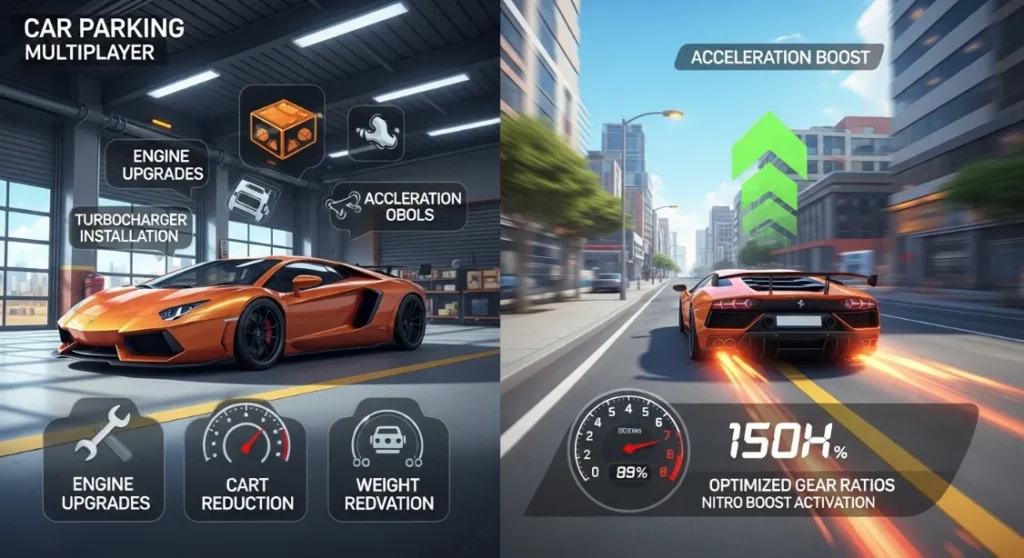
Mistake 1: The “Maximum Everything” Trap
Players max every upgrade and expect perfection. A 2000 HP car with random gearing and the wrong drive mode loses to a correctly tuned 1000 HP car. My 2000 HP Koenigsegg Jesko on stock gearing runs 12.8-second quarter-miles, slower than my 1200 HP BMW M5 with optimized gears at 11.4 seconds. For a full high-power build order, see our 2000HP build guide.
Mistake 2: Copying Settings Without Understanding Them
YouTube and TikTok are full of “best gearbox settings” videos. Those settings were tuned for one player, one map, one race type and one car. I copied a “perfect Supra setup” once, and the car felt terrible, because the video showed drift settings and I was drag racing.
Mistake 3: Ignoring Weight Distribution
The game does not show weight distribution clearly, but it differs by vehicle. Mid-engine supercars (McLaren, Ferrari) handle differently from front-engine muscle cars (Mustang, Challenger). For drag racing you want more weight over the driven wheels, so RWD cars like rear bias and AWD cars want balance. I shift weight by adding or removing body panels.
How Do You Test and Validate a CPM Tune?
Quick answer: change one variable at a time, run each setup 5 times, drop the fastest and slowest runs, and average the middle three.
The 4-Step Testing Loop
This beats random tweaking. After 200+ documented tests, I predict the effect of a change with about 85 percent accuracy.
The Quarter-Mile Benchmark
Use the airport runway for consistent 400 m tests. Mark your start point, accelerate through exactly 400 meters and note the time. Keep a spreadsheet of every setup change and its result.
Highway Top Speed Validation
For top speed, use the longest straight on the highway map. Start from the speed limit sign, accelerate to your maximum and note the peak before you brake for the curve. Weather and traffic do not exist in CPM, so results should cluster within 2-3 km/h. A spread of 10+ km/h means inconsistent racing lines or shift points.
In What Order Should You Upgrade a Car in CPM?
Quick answer: engine first, then turbo and intercooler, ECU tuning, tires, suspension and finally weight reduction. Each upgrade builds on the one before it.
Upgrade Order for Every Build
Follow this order, then tune the gearbox for your race type.
FAQ: Speed and Acceleration Tuning in CPM 2026
The Final Word: Test, Document, Then Tune Again
Speed in Car Parking Multiplayer comes from how engine power, gear ratios, weight and drive mode work together. Every upgrade is a trade-off: horsepower against control, top speed against acceleration, traction against velocity. The players who top leaderboards are not the ones with 2000 HP monsters. They are the ones who tested, documented and built setups for a specific race type.
Start with engine upgrades, then tune the gearbox for your main use: drag, circuit or top speed. The gap between a mediocre and a competitive build is about 50 hours of deliberate testing, not 5 million more coins.
Your Quick Tuning Checklist
Do these four things before you spend more coins.
What is your biggest tuning challenge right now: drag launches, losing top-end speed, or balancing a circuit build? Tell us in the comments.
Get the game from the Car Parking Multiplayer Mod APK page and the Android, iOS and PC guides, or compare CPM1 vs CPM2. Official game: CPM on Google Play · CPM2 on Google Play.
Related guides: Drift Settings · 2000HP Build · Top 5 Fastest Cars · Best Cars for Beginners · Tips and Tricks 2026 · Gift Box Locations · CPM1 vs CPM2