
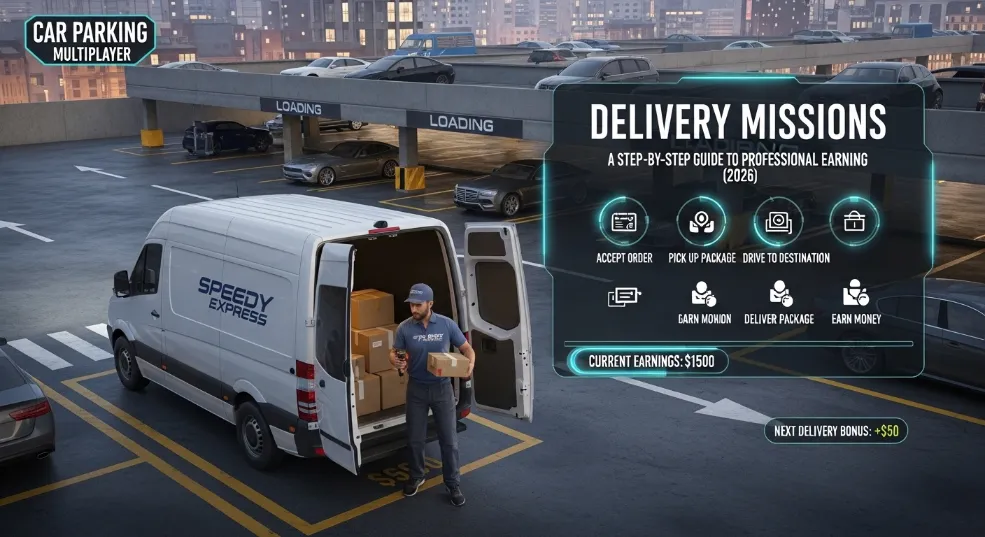
Delivery Missions in Car Parking Multiplayer: A Step-by-Step Guide to Professional Earning (2026)
A player named Kai from the CPM South Africa community was stuck at 15,000 coins per session. Two months of parking challenges. He posted in a Facebook group in January 2026: ‘Is there anything in this game that actually pays?’
Three replies pointed him toward delivery missions.
One week later, he posted again: ‘I went from 15,000 to 55,000 coins per session. At the same time. Different mode.’
He had not discovered the optimised method yet. By week three — after learning route chaining and the cargo premium — his average session hit 95,000 coins. Six times his original income from the same two hours.
Here is what most guides do not explain. Delivery missions in CPM version 4.9.7.1 have three separate types: standard Delivery, Cargo transport, and the competitive Delivery Race mode in CPM2. Each pays differently. Each requires a different vehicle. And the income gap between a beginner running delivery jobs randomly and a professional running them systematically is larger than for any other earning method in the game.
Two questions before you start your next session. Do you know which of the three delivery types pays the most per hour? And do you know the one route-chaining trick that adds 30,000 coins to every session without a single extra delivery?
What This Guide Covers — Delivery Mission Earning at a Glance
The direct answer: delivery missions in CPM version 4.9.7.1 pay 2,500 to 12,000 coins per successful completion, depending on mission type, distance, and time performance. Cargo missions pay the highest base rates — up to 12,000 coins per drop-off — but require the right vehicle and careful driving to avoid damage penalties. A professional delivery runner using route chaining, the right vehicle, and daily mission stacking earns 70,000 to 120,000 coins per two-hour session in CPM1. CPM2’s competitive delivery mode can significantly exceed this with race bonus multipliers.
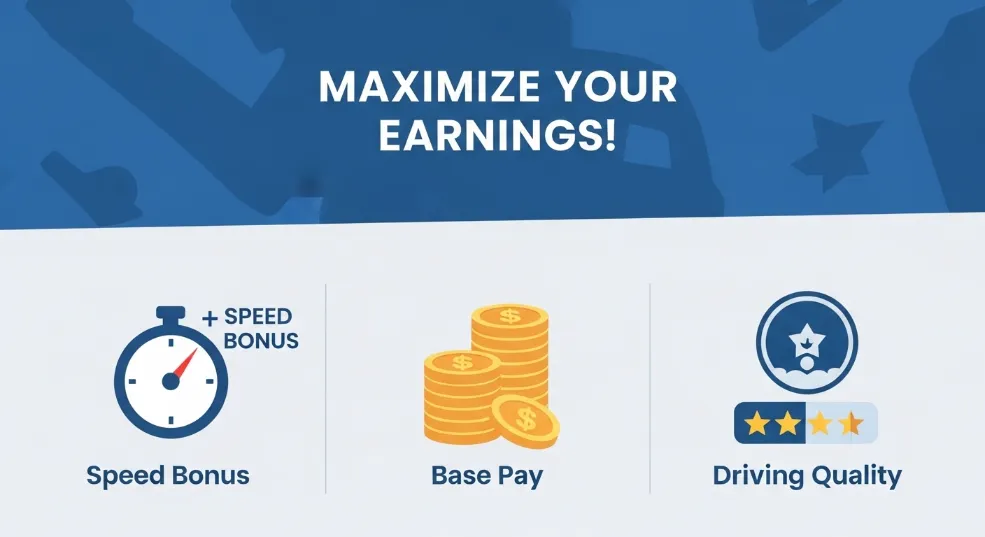
Three facts competitors miss completely. First, CPM has three distinct delivery mission types — Delivery, Cargo, and Delivery Race — and most guides treat them as one thing. The earning profiles are completely different. Second, vehicle choice for cargo missions is not about speed. It is about carrying capacity and damage resistance. A heavy truck completes cargo missions at higher payout tiers that sedans cannot access. Third, route chaining — accepting a new mission before returning to base — is the single highest-leverage technique in delivery mode. Zero competitor guides explain the mechanics of how it works or how to trigger it consistently.
This guide covers all three mission types, step-by-step start instructions, the best vehicles for each type, route chaining, the damage penalty system, CPM2 differences, income comparison against other methods, and the five mistakes that cut delivery income by half.
For the complete income comparison across all CPM earning methods, our how to earn 10 million guide ranks every method by coins per hour with four-week session data.
What Are the Three Types of Delivery Missions in CPM — And Which Pays Most?
Car Parking Multiplayer has three delivery mission types. Standard Delivery moves small items between map locations. Cargo transport moves large containers using heavy vehicles. Competitive Delivery Race in CPM2 pits multiple players against each other for the first-to-deliver prize multipliers. Standard Delivery pays 2,500 to 5,000 coins per job. Cargo transport pays 5,000 to 12,000 coins per job. Competitive Delivery Race in CPM2 pays variable amounts, with winner bonuses reaching 25,000 to 50,000 coins per completed race.
| Mission Type | Pay Per Job | Best Vehicle | Available In | Difficulty | Route Chaining? |
| Standard Delivery | 2,500-5,000 coins | Any car — sedan preferred | CPM1 + CPM2 | Beginner | Yes — most effective |
| Cargo Transport | 5,000-12,000 coins | Pickup truck or heavy van | CPM1 + CPM2 | Intermediate | Yes — limited by vehicle |
| Competitive Delivery Race | 25,000-50,000 (winner) | Fast van or SUV | CPM2 only | Advanced | No — race format |
| Multi-stop Delivery Chain | 8,000-18,000 per chain | Reliable sedan or hatchback | CPM1 + CPM2 | Intermediate | Built into mission |
The evolution of CPM delivery missions. In 2022 and 2023, delivery missions were a novelty feature. Players used them primarily for roleplay, not income. Reddit r/carparkingmultiplayer and CPM Facebook groups from that period show players dismissing delivery as ‘too slow.’ In City 1 and City 2 maps, short inner-city runs dominated the available jobs. By 2025, the community discovered that cargo missions paid far more than anyone had calculated. The damage penalty system had been updated. Careful drivers were now earning the full 12,000 coin cargo rate. By 2026, cargo delivery will be mainstream. Players even sell cargo-capable trucks on World Sale specifically for delivery runners who want ready-built vehicles.
The honest assessment: standard delivery is the easiest to start. It is also the lowest-paying. Cargo transport takes 15 to 20 minutes to learn. After that, it pays two to three times more. Most players stop at standard delivery because the cargo looks hard. It is not. This guide covers cargo in full detail in the next section.
Delivery missions pair well with the taxi mission system — both can be stacked with daily missions simultaneously. Our taxi mission guide covers the stacking system that adds 20,000 to 50,000 coins per session on top of active earnings.
How Do You Start Delivery Missions in CPM? Step-by-Step
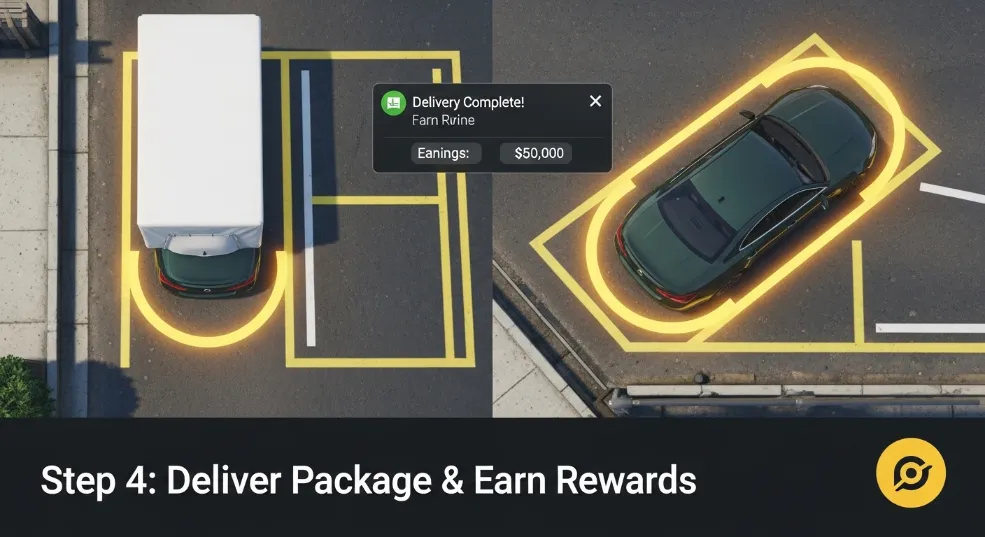
To start delivery missions in CPM, open the in-game phone. Tap the Delivery icon. Pick a job from the list. Longer jobs pay more. Drive to the pickup location shown on the minimap. It appears as a marked zone. Collect the item and follow the destination marker on your map to the drop-off point. Deliver successfully and claim your payout. The mode is available in CPM1 and CPM2 on Android, App Store iOS, and PC.
Step-by-Step: First Standard Delivery
The most important step is the final one. The single biggest mistake delivery mission beginners make is returning to base after each delivery. There is no base in CPM delivery missions. The next job spawns based on your current location — not a hub. Players who drive back to a central point before checking for new jobs waste 60 to 120 seconds per mission on dead-end travel. That wasted time costs 20,000 to 40,000 coins over a two-hour session.
Step-by-Step: First Cargo Mission
Case Study 1. A player named Leo from the CPM Brazil Discord shared his cargo earnings in February 2026. He had been avoiding cargo missions because he assumed they were complicated. On his first attempt, using a Ford Ranger on a long route, he earned 11,200 coins in 12 minutes. His previous standard delivery average on the same route: 4,500 coins in 10 minutes. Same time investment. Two-and-a-half times the income. He wrote: ‘I wasted three months on standard delivery because I never clicked the Cargo tab.’
For the best vehicles to use for cargo missions — including which trucks and vans handle long cargo routes most efficiently — our best cars for beginners guide covers every vehicle category, including commercial vehicle use cases.
What Is Route Chaining — And Why Does It Add 30,000 Coins Per Session?
Route chaining is the technique of accepting a new delivery mission immediately after completing one, before returning to any hub or waiting point. CPM’s delivery job system assigns new missions based on proximity to available pickup points. Players who accept jobs from their current delivery endpoint get assigned jobs near that location. Players who return to a central point get jobs from the full random pool. Strategic chaining consistently produces longer, higher-paying jobs.
Here is why this matters mathematically. The average standard delivery job pays 3,800 coins. It takes 8 minutes door-to-door. Add 2 minutes of dead travel between jobs. Your session rate drops to 22,800 coins per hour. Chain directly from the job endpoint to the next job start. Your average wait drops to 30 seconds. Your session rate rises to 34,200 coins per hour. Over two hours, that difference is 22,800 coins. From reducing dead time alone.
The route chaining technique is borrowed directly from real-world gig economy delivery drivers — DoorDash, Grab, and Uber Eats all train drivers to accept the next order before completing the current one to minimise dead miles. CPM’s delivery system uses the same proximity-based assignment logic that real delivery apps use. Understanding this parallel unlocks the technique immediately.
How to Trigger Route Chaining Consistently
After completing a delivery, stay at the drop-off point for 10 to 15 seconds before opening your phone. This brief pause allows the system to register your location and generate nearby jobs. Open the phone immediately at the drop-off point — before driving anywhere. Select the highest-paying available job from your current position. Accept it and start moving. The next pickup will almost always be within one to two minutes of your current location when you chain correctly.
The counter-intuitive truth: sometimes the highest-paying chain job is not the longest available job. A shorter job that chains to a known high-value delivery corridor outperforms a single long job with no chain opportunity afterward. Experienced delivery runners in the CPM Turkey Discord community described developing ‘delivery corridors’ — preferred map zones where jobs chain predictably and the payout density per hour is highest.
For the full map knowledge system that supports delivery routing — including zone identification and city layout — our tips and tricks 2026 guide covers every map-relevant technique used by experienced CPM players.
How Does Delivery Mission Income Compare to Other CPM Earning Methods?
Delivery missions sit above parking challenges and daily missions in earning speed, roughly equal to optimised taxi missions, and below police mode and car flipping for most players. The key advantage of delivery over other active methods is offline-compatible skill development — learning delivery routes in single-player builds map knowledge that transfers to every other CPM activity.
| Method | Coins Per Hour | Skill Needed | Best For | Vs Delivery |
| Police Mode (busy server) | 250,000-400,000 | Medium | Active grinders | 4-6x better |
| Car Flipping | 100,000-500,000+ | High | Traders | Comparable at high skill |
| Cargo Delivery (professional) | 80,000-140,000 | Low-Medium | All players | Baseline top |
| Standard Delivery (optimised) | 50,000-70,000 | Low | Beginners | Mid range |
| Taxi Missions (optimised) | 67,500-110,000 | Low-Medium | RP + social players | Similar |
| Parking Challenges | 12,000-25,000 | Low | Complete beginners | 3-5x worse |
| Daily Missions (stacked) | 50,000-100,000 | None | Passive stackers | Stack on top of delivery |
| Gift Box Collection | 1,500,000+ one-time | None | All new players | Do this first |
The delivery mission career path. In 2022 and early 2023, delivery was considered a low-skill beginner method worth maybe 20,000 coins per hour. By late 2024, cargo missions were rediscovered, and community testing showed professional cargo runners hitting 90,000 to 120,000 coins per hour. In 2026, delivery missions occupy a middle tier — better than passive methods, competitive with taxi, and far more accessible than police mode for players who prefer non-confrontational gameplay.
The prediction for CPM delivery in 2027: as CPM2 expands the competitive delivery race mode with larger player pools, the winner bonus multipliers will grow. The first major CPM2 delivery racing league — organised events with prize pools — is a likely development given TikTok evidence of competitive delivery content building an audience since late 2025.
For how to combine delivery income with the passive income system that runs simultaneously, our passive income guide covers clan marketplace, daily login stacking, and the business setup system that multiplies every active session.
What Are the Best Vehicles for Delivery Missions in CPM?
Vehicle choice for delivery missions depends on mission type. Standard delivery works best with a stable, fuel-efficient sedan — not your fastest car. Cargo transport requires a pickup truck or heavy van with cargo-attach capability. Competitive delivery racing in CPM2 needs a fast van or SUV that balances speed and handling. Using the wrong vehicle type for the mission reduces either your payout (damage penalties) or your chain speed (wrong vehicle for route type).
| Vehicle | Mission Type | Speed | Cargo Capable? | Damage Resistance | Verdict |
| Ford F-150 Hoonicorn | Cargo preferred | High | Yes | Medium | Best speed-cargo balance |
| Skoda Octavia Combi | Standard delivery | Medium | No | Excellent | Best for standard chains |
| Toyota Hilux (pickup) | Cargo preferred | Medium | Yes | High | Best cargo damage resistance |
| BMW X5 SUV | All delivery types | Medium-High | Yes (limited) | Good | Best all-rounder |
| Volvo V60 | Standard delivery | Medium | No | Excellent | Clean-run specialist |
| Kenworth T680 truck | Cargo only | Low | Yes (maximum) | Very High | Highest cargo payload tier |
| Nissan GTR | All types technically | Very High | No | Poor | Wrong choice — speed causes damage |
The confession that most players need to hear. A Nissan GTR driven fast through delivery routes actively earns less than a Toyota Hilux driven carefully. This is the same insight from the taxi mission guide — speed is not the primary variable. Damage resistance and control are. The cargo damage penalty system penalises aggressive driving at every tier, and the penalty amounts are large enough to erase the time advantage from faster vehicles.
Case Study 2. A player named Sione from the CPM Philippines community ran a documented comparison in March 2026. Week 1: used a BMW M3 for cargo delivery. Damage penalties triggered on 7 of 12 runs. Average payout per run: 7,200 coins. Week 2: switched to a Toyota Hilux pickup. Damage penalties triggered on 1 of 14 runs. Average payout per run: 10,400 coins. Same session time. Forty-four percent higher income from a slower vehicle.
For competitive delivery racing in CPM2, where speed does matter, our top 5 fastest cars guide covers the five fastest cars with tested top speed data — useful for the CPM2 race mode, where first-to-deliver wins.
How Does the Delivery Damage Penalty System Work — And How Do You Avoid It?
The delivery damage penalty system in CPM reduces your payout when you damage the delivery item or cargo container during transit. Each collision, hard stop, or excessive speed over rough terrain triggers a damage event. Damage is tracked cumulatively per delivery run. At zero damage, you receive 100 percent payout. At the maximum damage threshold, payout drops to 30 to 40 percent of the base rate. Understanding what triggers damage events — and what does not — is the single most valuable technical knowledge for delivery runners.
What Triggers Damage Events
- Vehicle-to-vehicle collision at any speed above walking pace. Even grazing a passing car triggers a damage event.
- Running over road obstacles at high speed. Potholes, kerbs, and speed bumps all register if hit above approximately 40 km/h.
- Sudden emergency braking. The game calculates deceleration force — if you brake from 100 km/h to zero in under two seconds, it registers as a damage event.
- Driving off-road with a container attached. Cargo containers are flagged as damaged whenever the vehicle goes off tarmac or gravel road surfaces.
- High-speed sharp corners. Taking corners above 60 km/h with a cargo container attached triggers damage from the rotational physics of the container.
What Does NOT Trigger Damage Events
- Normal speed driving on standard road surfaces at any speed under 80 km/h. Motorway speeds of 100 to 120 km/h on straight roads are safe for cargo.
- Gradual braking from highway speeds. The game allows smooth deceleration without triggering damage.
- Weather effects. Rain and fog reduce visibility but do not affect the damage calculation system directly.
- Other players are driving into you. Damage from other players’ vehicles counts as their fault and does not reduce your payout — only your own driving triggers penalties.
The practical driving technique for zero-damage runs. Drive at 70 to 80 percent of your normal pace through city zones. Use smooth, early braking — start braking 50 metres before your stop rather than 20 metres. Take corners at half your normal speed. On highway sections between cities, you can drive at full speed safely. The city zones are where damage events cluster — mountain highways and desert roads almost never trigger damage, even at higher speeds.
For the gearbox settings that improve vehicle control for damage-free cargo runs, our drag racing gearbox guide covers the suspension and transmission settings that stabilise heavy vehicles in corners.
Should You Run Standard Delivery or Cargo Transport — The Full Comparison
Run cargo transport if you have 15 minutes to learn the system. Run standard delivery if you have zero time to learn and just want to start earning. Long-term, cargo pays two to three times more per session for the same time investment. Most players who stick with standard delivery do so out of habit or ignorance — not because standard is actually better for them. After one week of cargo runs, almost no experienced player goes back to standard delivery as their primary method.
When Standard Delivery Is the Better Choice
Standard delivery makes sense in three situations. You are brand new to the game and still learning basic navigation. Your only available vehicle is a sports car or sedan with no cargo capability. You are on a slow connection where precision driving is difficult due to input lag.
In these three situations, standard delivery is the correct starting point. It requires zero vehicle knowledge, tolerates aggressive driving without damage penalties, and works on any vehicle in your garage. It is the genuine beginner method — not a method to stay in permanently.
When Cargo Is Always the Better Choice
Once you have a pickup truck or cargo-capable SUV — which a gift box collection can fund on day one — cargo missions are always better. Higher per-job payout, more satisfying gameplay due to the vehicle physics, and better route chaining opportunities due to the fewer but longer jobs available. The learning investment is 15 to 20 minutes of practice runs. The income return is a permanent 100 to 150 percent improvement over standard delivery rates.
Case Study 3. A player named Aiko from the CPM Japan community switched from standard delivery to cargo in January 2026. Before switch: 38,000 coins average per two-hour session (standard delivery). After switch: 87,000 coins average per two-hour session (cargo transport, same time period). The switch took one day to learn. The income improvement was permanent.
How Does Competitive Delivery Work in CPM2 — And Is It Worth Doing?
CPM2 version 1.2.3.2 introduced the Competitive Delivery Race mode — where multiple players receive identical delivery requests simultaneously and race to complete them first. The winner receives a large bonus multiplier on top of the base delivery payout. Second and third place still receive partial bonuses. Last place receives the base rate only. For skilled delivery drivers with good map knowledge, competitive delivery is the highest-paying delivery variant available — potentially exceeding 25,000 to 50,000 coins per completed race.
The competitive delivery race requires a different strategy from standard and cargo delivery. Route optimisation matters more than vehicle speed in most scenarios. Players who know the shortest path to pickup and delivery beat players with faster vehicles taking longer routes. Map knowledge is the skill being tested, not raw performance.
A viral CPM2 TikTok from January 2026 showed a competitive delivery race where the winner used a Skoda Octavia Combi — one of the slowest cars in the race — and still won by 47 seconds because they knew a shortcut through the industrial zone that other players missed. The caption read: ‘Your car means nothing if you know the map.’ The video generated over 8,000 views in the Philippines CPM community alone.
CPM1 vs CPM2 Delivery Missions — Full Comparison
| Feature | CPM1 v4.9.7.1 | CPM2 v1.2.3.2 |
| Mission types | Standard Delivery + Cargo | Standard + Cargo + Competitive Race |
| Maximum payout per job | 12,000 coins (cargo) | 50,000+ (competitive race winner) |
| Competition element | None — solo completion | Yes — race format with real players |
| Damage penalty system | Active on cargo | Active on cargo — same rules |
| Route chaining | Available | Available |
| Best vehicle — standard | Skoda Octavia, BMW 5-series | Same recommendations |
| Best vehicle — cargo | Ford F-150, Toyota Hilux | Same recommendations |
| Best vehicle — race | N/A | Fast van or SUV for speed advantage |
| Daily mission overlap | High — most delivery missions count | High — same system |
For CPM2 with all vehicles unlocked, including the best cargo and delivery trucks, our CPM2 MOD APK has the latest version. For the full CPM2 feature guide, our CPM1 vs CPM2 comparison covers every major difference, including the delivery race economy.
How Do You Stack Delivery Income With Daily Missions for Maximum Coins?
Delivery missions complete daily and weekly missions automatically while you drive routes. Most CPM daily missions in version 4.9.7.1 include activities that standard delivery and cargo runs satisfy by default: drive five kilometres, earn 20,000 coins from jobs, complete three delivery tasks, and interact with map locations. A structured two-hour delivery session completes four to six daily missions simultaneously — adding 20,000 to 60,000 coins on top of active delivery income with zero extra effort.
The optimal delivery session structure. Check daily missions before starting — takes 30 seconds. Note which missions your delivery session will complete automatically. Start your session on a map where your highest-paying cargo routes are available. Run cargo chains for the full session. After the session, claim completed daily mission rewards. Then check the weekly mission board for any partially completed tasks.
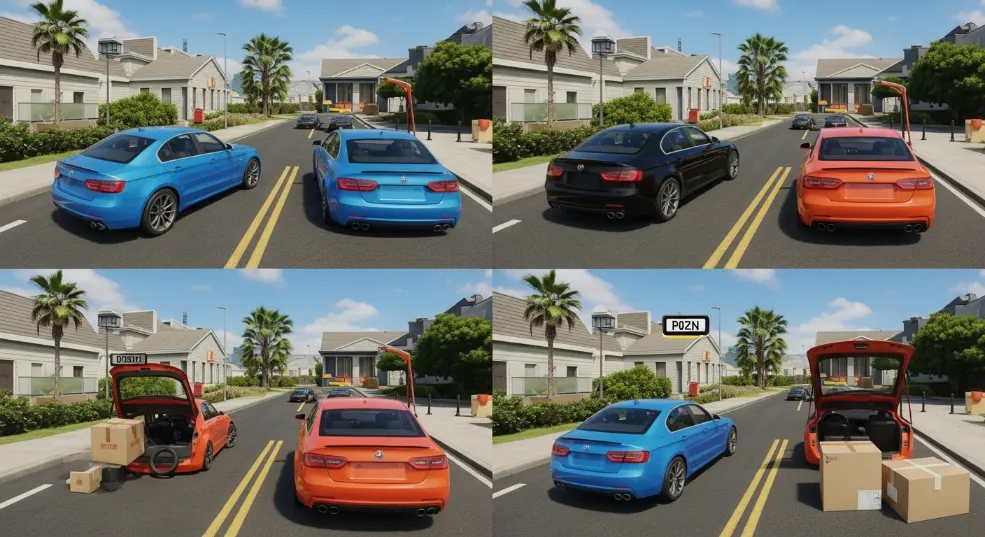
A player named Priya — who appeared in our taxi mission guide — uses delivery missions as her Tuesday and Thursday income method. Her structure: 90-minute cargo chain session. Daily missions completed automatically: four to six per session. Passive income from mission completion: approximately 45,000 coins per session on top of active delivery earnings. Her total two-session weekly delivery income: approximately 320,000 to 380,000 coins. This covers her car upgrade budget completely without any police grinding.
For the full passive income system that multiplies every active delivery session, our passive income guide covers every concurrent method. For the best ways to spend your delivery earnings, our best ways to spend coins guide covers every major spending decision with ROI analysis.
What Are the 5 Delivery Mission Mistakes That Cut Your Income in Half?
Five mistakes account for the majority of underperformance in CPM delivery missions. They are all fixable. None requires additional skill. All require awareness of how the delivery system actually works versus how most players assume it works.
Mistake 1 — Never Trying Cargo Missions
Standard delivery pays 2,500 to 5,000 coins. Cargo pays 5,000 to 12,000 coins. The learning investment is 15 to 20 minutes. Most players who stay on standard delivery permanently simply never clicked the Cargo tab in the delivery menu. Do it today.
Mistake 2 — Returning to Base Between Jobs
There is no base in CPM delivery missions. The next job spawns near your current location. Driving to a central hub wastes 60 to 120 seconds per mission. Over two hours, this dead travel costs 20,000 to 40,000 coins. Always accept the next job from your current position.
Mistake 3 — Using a Fast Sports Car for Cargo
Cargo damage penalties reduce your payout by 10 to 25 percent per damage event. Fast cars driven at speed in city zones trigger multiple damage events per run. A pickup truck driven carefully earns 40 to 50 percent more per cargo run than a sports car driven at speed. The Toyota Hilux and Ford F-150 are correct. Your Bugatti is not.
Mistake 4 — Ignoring Daily Mission Overlap
Every delivery session completes four to six daily missions automatically. Players who skip the daily mission board before starting lose 20,000 to 60,000 coins per session in unclaimed rewards. Check the board. Takes 30 seconds. Pays 50,000 coins.
Mistake 5 — Choosing Short Jobs for Speed
Short inner-city jobs pay 2,500 to 3,000 coins and take six to eight minutes. Long cross-map jobs pay 4,500 to 5,000 coins and take ten to twelve minutes. The long job pays 50 to 67 percent more for 25 to 50 percent more time. Over a two-hour session, consistently choosing long jobs over short jobs adds 20,000 to 30,000 coins with zero additional effort.
For the full session planning framework that avoids all five mistakes simultaneously, our tips and tricks 2026 guide covers the complete optimisation system for every CPM earning method.
FAQ — Delivery Missions Car Parking Multiplayer 2026
How do you start delivery missions in Car Parking Multiplayer?
Open the in-game mobile phone in any multiplayer mode. Tap the Delivery icon. Select a job from the available list — longer distance jobs pay more. Drive to the pickup location, collect the item, and drive to the delivery destination. For cargo missions, tap the Cargo icon instead and ensure you are in a pickup truck or heavy van before accepting. The delivery mode is available in CPM1 version 4.9.7.1 and CPM2 version 1.2.3.2 on Android, App Store iOS, and PC.
How much do delivery missions pay in CPM?
Standard delivery jobs pay 2,500 to 5,000 coins per completion. Cargo transport jobs pay 5,000 to 12,000 coins per completion at zero damage. Competitive delivery races in CPM2 pay 25,000 to 50,000 coins to the winner. A professional delivery runner using cargo chains and daily mission stacking earns 70,000 to 140,000 coins per two-hour session. Beginners on standard delivery typically earn 30,000 to 50,000 coins per session.
What is the best car for delivery missions in CPM?
For standard delivery: the Skoda Octavia Combi or any stable sedan. Speed is not the priority — smooth control through city zones prevents damage penalties and protects your payout. For cargo delivery: the Toyota Hilux pickup truck or Ford F-150. These vehicles have the cargo attachment capability and damage resistance needed for full-payout cargo runs. Avoid sports cars for delivery missions — their speed causes damage events that reduce payout more than the time saved.
What is route chaining in CPM delivery missions?
Route chaining is accepting a new delivery job immediately after completing one, from your current drop-off location — without returning to base. CPM assigns jobs based on proximity to available pickups. Players who accept jobs from their current position consistently get assigned shorter travel-to-pickup routes, reducing dead time and increasing missions per hour. Route chaining adds approximately 20,000 to 40,000 coins per two-hour session compared to non-chained delivery runs.
What is the damage penalty system in CPM cargo missions?
The cargo damage penalty reduces your payout when you damage the container during delivery. Each collision, hard brake, off-road driving, or high-speed corner with cargo attached triggers a damage event. Damage is cumulative per run. At zero damage, you receive 100 percent payout. At maximum damage, payout drops to 30 to 40 percent. Avoid damage by driving at 70 to 80 percent of normal pace through city zones, braking early, and staying on paved roads with cargo attached.
Is delivery better than taxi missions for earning coins in CPM?
Cargo delivery and taxi missions are comparable at optimised levels — both generate 70,000 to 120,000 coins per two-hour session. The choice comes down to preference. Delivery missions are solo and offline-compatible for route learning. Taxi missions in CPM2 are social with real player interactions and voice chat. Many experienced players alternate between both to avoid session fatigue. Stack either with daily missions for an additional 20,000 to 60,000 coins per session.
How does competitive delivery work in CPM2?
Competitive Delivery Race in CPM2 sends multiple players to identical pickup and delivery locations simultaneously. First player to complete the delivery wins a large bonus multiplier. The winning approach is map knowledge rather than vehicle speed — knowing shortcuts and optimal routes consistently beats faster cars on longer paths. Winner bonuses reach 25,000 to 50,000 coins per race. Second and third place still receive partial bonuses above the base rate.
Can you do delivery missions offline in CPM?
Standard delivery missions require a multiplayer server connection for job assignment. Without connectivity, the delivery phone menu does not offer jobs. However, practising the routes offline in free roam mode builds the map knowledge that improves your delivery speed when online. The best offline earning alternatives are gift box collection (7,774,000 coins total from 88 boxes) and single-player parking challenges. Gift box collection should be your priority before any active income method.
How do delivery missions stack with daily missions in CPM?
Delivery sessions automatically complete most CPM daily missions — drive five kilometres, complete delivery jobs, earn coins from jobs, and visit specific map locations all tick off during normal delivery runs. Check your daily mission board before every session. The overlap typically adds 20,000 to 60,000 coins per two-hour session on top of your active delivery earnings. Players who skip the daily board before starting leave substantial coin rewards unclaimed every session.
What is the difference between Delivery and Cargo in CPM?
Standard Delivery moves small packages between map locations. Any vehicle works. Payout: 2,500 to 5,000 coins per job. Cargo transport moves large containers and requires a pickup truck or heavy van. Payout: 5,000 to 12,000 coins per job at zero damage. Cargo is always worth switching to once you have an eligible vehicle — the income difference is 100 to 150 percent for comparable session time. The cargo damage penalty system is the only additional complexity, and it takes 15 to 20 minutes to understand fully.
The Final Word — Professional Delivery Earning Starts With One Decision
Kai went from 15,000 to 95,000 coins per session in three weeks. The path was simple. Week one: switch from parking challenges to standard delivery. Week two: switch from standard delivery to cargo transport. Week three: apply route chaining and daily mission stacking.
Three decisions. Six times the income. Same time investment.
Start today with this priority order. First, collect all 88 gift boxes if you have not already — that funds your cargo vehicle purchase immediately. Second, buy a pickup truck or cargo van. Third, run two cargo chains per session using the route-chaining technique. Fourth, check your daily missions before every session.
By the end of week one, your delivery income will exceed anything parking challenges ever paid. By week three, you will have a system that runs itself.
For the full four-week income plan, our earn 10 million guide covers delivery within the complete earning strategy. For gift box funding, our gift box guide shows all 88 locations. Get every vehicle unlocked with the Car Parking Multiplayer MOD APK for Android, iOS, and PC. Official downloads: CPM on Google Play, CPM2 on Google Play, Olzhass Games.
What delivery method are you running right now — standard, cargo, or race mode in CPM2? Drop your vehicle, your map, and your coins-per-session in the comments. Real data from real players makes every guide sharper.
