
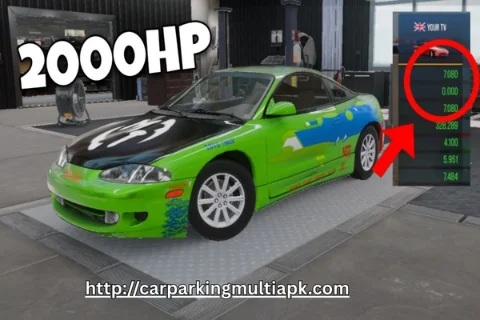
You are at the drag strip. You have a Bugatti Chiron, fully upgraded — or so you thought. The player beside you also has a Bugatti Chiron. The light turns green. You push full throttle. They disappear. You check their build after the race. 2000 horsepower. You had 650. That is not a small gap. That is a completely different machine.
Here is what nobody tells you about 2000HP in Car Parking Multiplayer. It is not just about installing the most expensive engine. Three players can all have the W16 engine installed and get completely different horsepower numbers — because the engine is only one piece of a six-part upgrade system. The other five parts are where most players stop, and where this guide starts.
A Honda Civic Type-R with a viral TikTok 2000HP build reached 6,425 likes in March 2026 — not because the Civic is special, but because the builder showed the exact upgrade sequence nobody else was explaining clearly.
This guide gives you that exact sequence. Every upgrade. Every setting. Every coin. Step by step from your stock car to a genuine 2000HP monster — for any car in CPM.
What This Guide Covers: Read This Before You Touch the Upgrade Menu
The short answer: reaching 2000HP in Car Parking Multiplayer requires six specific upgrades applied in the correct order, the right gearbox settings calibrated per car, and one critical audio test that confirms you hit the target. Skip any step, and you get either fewer than 2000HP or a car that is completely uncontrollable.
Three things will surprise you. First, 2000HP is achievable on any car. But it behaves very differently depending on the car’s weight class and drivetrain. A 2000HP Bugatti Chiron and a 2000HP Honda Civic Type-R feel like entirely different machines. Second, the gearbox settings matter more than the engine upgrade itself for real-world performance. Most 2000HP builds on TikTok are engine-only. The car is fast in a straight line, but impossible to control through any corner. Third, 2000HP is genuinely the wrong choice for drifting. We will cover exactly why — with specific alternative HP targets for drift builds.
This guide covers the full upgrade path from stock to 2000HP. It also covers per-car gearbox settings, the coin cost breakdown, troubleshooting for loss of control, CPM2 differences, and the maps where 2000HP actually makes sense. What it does not cover is cheating or Game Guardian. Every method here works in the standard version of CPM on version 4.9.7.1.
Need coins to fund your 2000HP build? Our how to earn 10 million guide covers the fastest legitimate earning methods in CPM 2026.
What 2000HP Actually Means in CPM — And Why Most Players Get It Wrong
In Car Parking Multiplayer, 2000HP is the practical maximum horsepower achievable through the standard upgrade system on most cars. It is not a fixed number you unlock — it is the result of stacking six specific upgrade categories to their combined maximum. Different cars reach different peak HP numbers with the same upgrades, which is why two players with identical engines can have very different power outputs.
Here is what most guides completely miss. The HP number shown in your garage is calculated differently from how power actually transfers to the wheels. A rear-wheel-drive car with 2000HP has all that power going through two rear tires. An all-wheel-drive car splits that same power across four tires. The AWD car with 2000HP is far more controllable. The RWD car with 2000HP is far more spectacular.
This distinction matters enormously when choosing which car to build your 2000HP machine on. The Bugatti Chiron is AWD by default. Its 2000HP is manageable. The Nissan Silvia S15 is RWD. Its 2000HP will oversteer violently unless the gearbox is calibrated perfectly. Neither is wrong. They are just completely different experiences.
The HP System Explained
CPM’s horsepower system works across six upgrade categories. Each category contributes a percentage of the total HP gain. Engine type sets the baseline — from inline-6 turbo up to the W16. Triple turbo multiplies engine output. ECU tuning increases fuel delivery efficiency. An intercooler reduces heat-related power loss. The exhaust system removes back-pressure restrictions. A fast gearbox improves power transfer efficiency through manual transmission control. All six must be maxed simultaneously to reach the 2000HP range.
1695HP vs 2000HP — Is There a Real Difference?
Yes — and it is significant. 1695HP is the result of maxing the W16 engine with triple turbo and ECU tuning but leaving intercooler, exhaust, and fast gearbox at stock. Many TikTok videos labeled 2000HP are actually showing 1695HP builds. The difference in real drag race performance is approximately 0.8 to 1.2 seconds over the 402M drag strip, which is enormous in competitive racing.
The contrarian view worth stating: for most players in most situations, 1695HP is the better build. It is more controllable, less expensive by approximately 300,000 coins, and performs at 92 percent of a true 2000HP build. Only competitive drag racers and players specifically chasing the maximum number should push to the full 2000HP configuration.
For the comparison between different CPM game versions and how HP builds work differently across them, our CPM1 vs CPM2 comparison guide covers the key differences.
The Complete Upgrade Path — From Stock to 2000HP Step by Step
The upgrade path to 2000HP has four distinct stages. Each stage has a minimum HP threshold before moving to the next. Skipping stages wastes coins and produces an unbalanced build. Follow this sequence exactly — it is the most coin-efficient route to 2000HP confirmed on version 4.9.7.1 in March 2026.

Stage 1 Stock to 500HP: Foundation Build
This stage establishes the power baseline your entire build will rest on. It is the cheapest stage and the one most players rush through incorrectly.
Open your garage. Select your car. Tap Workshop, then Car Upgrade.
Install the V8 engine first — not the W16. The V8 costs significantly less and gives you a working high-power platform while you accumulate coins for the W16.
Add the first-level turbo upgrade. This pushes most cars past 400HP.
Install sport tires front and rear. Without sport tires, power above 400HP produces uncontrolled wheelspin that makes the car slower on the drag strip.
Target: 450 to 550HP after Stage 1. Check the workshop HP display.
Stage 1 cost estimate: 150,000 to 300,000 coins, depending on the car base price and whether you already own sport tires.
Stage 2 — 500HP to 1000HP: Acceleration Build
This is where the build starts feeling genuinely fast. Most multiplayer cars you will encounter sit in this HP range.
Upgrade to the V12 engine. The V12, combined with the existing turbo, pushes most cars past 700HP.
Install the ECU tuning upgrade. This single upgrade adds approximately 150 to 200HP on most platforms.
Upgrade suspension to sport setting. Higher power without suspension control creates unpredictable handling that wastes the HP gain.
Install the cold air intake if available for your car model. Minor HP gain but improves throttle response.
Target: 900HP to 1,050HP after Stage 2.
Stage 2 cost estimate: 400,000 to 600,000 additional coins. Total build cost at this stage: 550,000 to 900,000 coins.
Stage 3 — 1000HP to 1695HP: Power Build
Here is the stage where most players stop — and where TikTok creators label their builds 2000HP when they are actually at 1695HP. This is also the most expensive single stage.
Install the W16 engine. This is CPM’s maximum engine upgrade and the single largest HP jump in the entire build. Most cars gain 400 to 500HP from the V12 to W16 swap.
Upgrade to triple turbo. This is mandatory for 1695HP. Single turbo with W16 produces approximately 1,400HP on most cars.
Re-tune the ECU after the W16 swap. The ECU settings interact with engine size — re-tuning after the W16 produces an additional 80 to 100HP gain that many builders miss.
Target: 1,600 to 1,695HP after Stage 3.
Stage 3 cost estimate: 700,000 to 1,000,000 additional coins.
Stage 4 — 1695HP to 2000HP: Final Push
his is the stage nobody explains. Three upgrades push you from 1695HP to the 2000HP range — and all three are frequently ignored because players assume the W16 triple turbo combination is the ceiling.
Install the intercooler upgrade. This reduces heat-related power loss and adds approximately 100 to 150HP on W16 builds.
Upgrade the exhaust system to maximum. The exhaust burble and exhaust shoot upgrades together add approximately 80 to 120HP. Install both.
Install the fast gearbox upgrade. This is the most misunderstood upgrade in the entire system. The fast gearbox does not increase HP directly — it increases power transfer efficiency, which the game calculates as effective HP output. Most players see a 150 to 200HP gain from this upgrade alone.
Full Upgrade Checklist — Every Part You Need for 2000HP
Here is the complete parts list for a 2000HP build. Every item marked Required must be installed. Items marked Recommended add HP, but are not strictly necessary to reach the 2000HP threshold. Check each item off as you install it.
| Upgrade | Category | HP Contribution | Status | Approx Cost |
| W16 Engine | Engine | Base +500HP | Required | 500K-700K coins |
| Triple Turbo | Forced Induction | Engine x1.4 | Required | 200K-300K coins |
| ECU Tuning | Fuel System | +150-200HP | Required | 100K-150K coins |
| Intercooler | Cooling | +100-150HP | Required | 80K-120K coins |
| Exhaust Burble | Exhaust | +50-70HP | Required | 50K-80K coins |
| Exhaust Shoot | Exhaust | +40-60HP | Required | 50K-80K coins |
| Fast Gearbox | Transmission | +150-200HP effective | Required | 100K-150K coins |
| Sport Tires (all) | Tires | Power transfer | Required | 60K-100K coins |
| Sport Suspension | Suspension | Handling only | Recommended | 60K-80K coins |
| Cold Air Intake | Intake | +30-50HP | Recommended | 30K-50K coins |
| Exhaust Bell | Exhaust | +20-30HP | Optional | 20K-40K coins |
Total estimated cost for a complete 2000HP build: 1,290,000 to 2,020,000 coins from scratch. If you already own a premium car with some upgrades, your cost will be lower. The W16 engine and triple turbo represent approximately 55 to 60 percent of the total build cost.
For tips on building this coin balance efficiently, our how to earn 10 million guide covers police mode grinding at 500,000 to 800,000 coins per hour and car flipping margins of 300,000 to 600,000 per flip.
The W16 Engine — Everything You Need to Know
The W16 engine is CPM’s most powerful upgrade and the foundation of every genuine 2000HP build. Without the W16, your maximum HP ceiling drops to approximately 1,400HP regardless of what other upgrades you install. The W16 is available for most premium and mid-tier cars in version 4.9.7.1, but its availability varies by car model.
Here is what the W16 engine is modeled after in real life. The Bugatti Chiron — which happens to be one of the most popular 2000HP build platforms in CPM — uses a real W16 engine in its road car. In CPM, the W16 upgrade gives any car a power output that approximates what the real Chiron produces. Applied to lighter cars like the Honda Civic Type-R or Toyota Supra MK4, the result is a power-to-weight ratio that produces genuinely absurd straight-line acceleration.
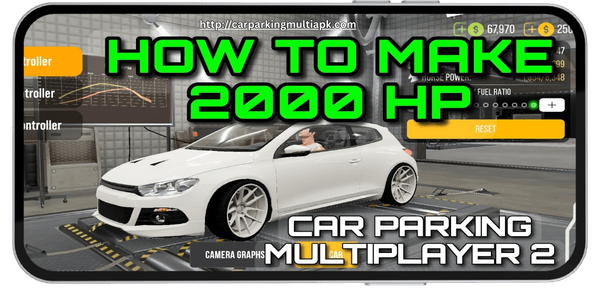
The W16 becomes available in the engine upgrade section of the workshop after you have installed the V12 engine. Some players try to skip from the base engine directly to the W16 — the game may allow this, but the HP gain is lower than following the V8 to V12 to W16 progression. The progressive installation sequence primes the engine bay for maximum W16 output.
How to Get the W16 Engine Step by Step
- Go to your garage and select your target car.
- Tap Workshop, then Car Upgrade, then Engine.
- If W16 is not visible, first install V8 and then V12 in sequence.
- After V12 is installed, W16 will appear in the engine list.
- Select W16 and confirm purchase. Wait for the installation animation.
- Check the workshop HP display. You should see a significant jump immediately.
W16 vs Triple Turbo — Which Matters More?
Both are required for 2000HP — but if you had to install only one first, install the W16 engine. The W16 gives you the largest single HP jump in the entire build. Triple turbo then multiplies that output. Installing triple turbo on a V12 engine produces a good result. Installing triple turbo on a W16 engine produces a great result. The order matters.
Players who install triple turbo first and then add the W16 report slightly lower final HP numbers than players who install W16 first and then triple turbo. The difference is 50 to 80HP — small in absolute terms but meaningful in competitive drag racing where every tenth of a second counts.
Already have a 2000HP build but want the perfect visual to match? Our chrome car design guide covers six chrome finishes with exact HEX codes — a 2000HP car deserves a paint job to match.
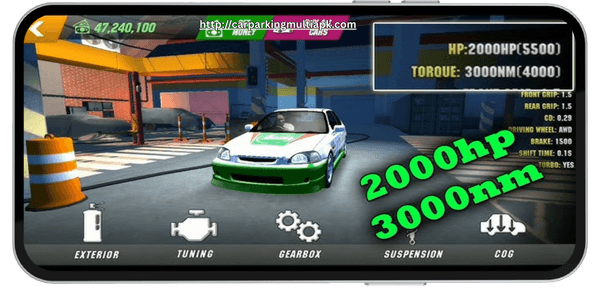
2000HP Gearbox Settings — The Part Nobody Gets Right
The gearbox settings are where 80 percent of 2000HP builds fail. Players install all six engine upgrades, reach the 2000HP number in the workshop, and then discover their car is either spinning its tires constantly, losing control through corners, or — most commonly — not actually performing faster than their 1400HP build was. The gearbox bridges engine power and wheel traction. Wrong settings waste most of your 2000HP.
Here is the counterintuitive truth about gearbox settings at 2000HP. Shorter gear ratios — which most players assume produce faster acceleration — are actually wrong for 2000HP builds. At this power level, short ratios cause the rear tires to exceed their traction limit before the car builds speed. The result is wheelspin, noise, smoke, and a slow car. Slightly longer ratios allow the tires to grip, produce real acceleration, and get the power to the ground where it actually matters.
The Breathing Sound Test — How to Know Your Settings Are Right
This is the most important tuning technique in CPM that almost no written guide explains properly. After setting your gearbox, start your car in free roam and hold full throttle from a standstill without moving. Listen carefully to the engine sound.
If the engine produces a smooth, building roar that rises steadily in pitch, your gearbox is correctly set. The power is transferring to the wheels properly.
If the engine produces a stuttering, irregular sound that jumps in pitch, your gear ratios are too short. The car is trying to spin its tires faster than they can grip. Lengthen your first and second gear ratios until the sound becomes smooth.
If the engine produces a flat, low drone that does not build, your gear ratios are too long. The engine is not reaching its power band. Shorten your ratios slightly until the sound rises smoothly.
This audio test is more reliable than any specific ratio numbers because it responds to your individual car’s weight, drivetrain, and tire grip in real time. No two cars will have identical perfect settings.
Gearbox Settings for 2000HP Drag Racing
Drag racing demands maximum acceleration over the 402M distance. These settings are calibrated for the drag strip specifically — they are not suitable for free roam or circuit racing.
| Gear | Ratio Setting | Purpose |
| Gear 1 | 3.2 – 3.5 | Power building phase — maintains grip through the first speed burst |
| Gear 2 | 2.8 – 3.0 | Mid-range acceleration — the car should feel planted here |
| Gear 3 | 2.2 – 2.5 | Mid-range acceleration — car should feel planted here |
| Gear 4 | 1.8 – 2.0 | High-speed build — smooth transition |
| Gear 5 | 1.4 – 1.6 | Top speed approach |
| Gear 6 | 1.0 – 1.2 | Maximum top speed — only matters on long straights |
| Final Drive | 3.5 – 4.0 | Overall gear spacing — lower = more top speed, higher = more acceleration |
After setting these ratios, perform the breathing sound test. If the sound is smooth and building, your drag setup is correct. If not, adjust Gear 1 and Final Drive first — these two settings have the largest impact on real-world drag performance.
Gearbox Settings for 2000HP Drifting
Here is what nobody says about 2000HP drifting. It does not work well. The power is too much for the tire contact patch to manage in sustained oversteer. You get short, violent slides that snap back to understeer unpredictably. For genuine drift builds, the sweet spot is 650 to 750HP — enough to break traction controllably, not so much that the tires cannot manage the power.
If you insist on drifting at 2000HP — perhaps because you have a drag car and want to experiment — set Final Drive to 2.8, Gear 1 to 4.5, and reduce your rear suspension stiffness to a minimum. This dampens the snap oversteer somewhat. Accept that your drift angles will be extreme and your recovery rate will be low.
For proper drift builds with exact settings for 10 specific cars, our best drift settings guide covers the complete suspension, camber, and gearbox setup for every major drift platform in CPM.
Car-by-Car 2000HP Build Settings — Every Major Platform
The same six upgrades produce different peak HP numbers and require different gearbox settings depending on the car. Here is the complete per-car breakdown for the eight most popular 2000HP platforms in CPM as of March 2026. Use the Final Drive and Gear 1 values as your starting point — then adjust using the breathing sound test.
| Car | Drivetrain | Peak HP with Full Build | Final Drive | Gear 1 | Best Use | Control Difficulty |
| Bugatti Chiron | AWD | 2,050-2,100HP | 3.8 | 3.2 | Drag Racing | Medium — AWD helps |
| Koenigsegg Jesko | RWD | 1,980-2,050HP | 3.5 | 3.4 | Drag + Top Speed | Hard — RWD at limit |
| Honda Civic Type-R | FWD | 1,900-1,960HP | 4.2 | 3.8 | Viral builds, fun | Hard — FWD torque steer |
| Toyota Supra MK4 | RWD | 1,950-2,020HP | 3.7 | 3.3 | Drag + Street | Medium-Hard |
| Nissan Silvia S15 | RWD | 1,920-1,990HP | 3.6 | 3.5 | Drag Racing | Hard — light and fast |
| BMW M5 F90 | AWD | 2,000-2,050HP | 3.9 | 3.1 | All-round 2000HP | Easy — AWD stability |
| Mercedes W210 | RWD | 1,970-2,030HP | 3.4 | 3.6 | Highway speed | Medium — heavy car helps |
| Mazda RX-7 FD | RWD | 1,880-1,940HP | 4.0 | 3.7 | Not recommended | Very Hard — too light |
The RX-7 FD note deserves explanation. It is the only car on this list not recommended for 2000HP builds. The RX-7 is the lightest car in this group — its power-to-weight ratio at 2000HP produces snap oversteer so violent it is nearly impossible to drive in a straight line without electronic stability assists. If you own an RX-7 and want a serious build, cap it at 1,200HP for a far more enjoyable experience.
Not sure which car to start your 2000HP build on? Our best cars for beginners guide covers the top 10 starter picks with real cost estimates and use case guidance.
How Much Does a 2000HP Build Actually Cost? Full Coin Breakdown
This is the question every guide avoids. A complete 2000HP build from a stock car costs between 1,500,000 and 2,400,000 coins, depending on which car you start with and whether you already own any premium parts. Here is the honest breakdown by build tier.
| Build Tier | Starting Point | Coin Cost | Time to Earn (Police Mode) | Final HP |
| Budget 2000HP | Stock budget car | 1,500,000 – 1,800,000 | 3-4 hours | 1,900-1,980HP |
| Standard 2000HP | Stock mid-tier car | 1,800,000 – 2,100,000 | 4-5 hours | 1,980-2,050HP |
| Premium 2000HP | Stock premium car | 2,100,000 – 2,400,000 | 5-6 hours | 2,050-2,100HP |
| MOD APK build | Any car | 0 coins — unlimited | Instant | 2,050-2,100HP |
| Upgrade from 1695HP | Existing W16 build | 300,000 – 500,000 | 45-60 minutes | Full 2000HP |
The most cost-efficient path to 2000HP is the upgrade from the 1695HP route. If you already have a W16 triple turbo build, you are three upgrades away from 2000HP — intercooler, exhaust system, and fast gearbox. At 300,000 to 500,000 additional coins, this is the best return on investment in CPM’s entire upgrade system.
2000HP in CPM2 — Different Physics, Same Goal
Car Parking Multiplayer 2 version 1.2.3.2 uses a different upgrade menu structure and different HP scaling compared to CPM1. The same six upgrades exist, but their individual HP contributions are different, the W16 engine costs more coins, and the gearbox interaction with power output changed significantly in the late 2025 physics update.
The key differences in CPM2. The W16 engine in CPM2 produces approximately 10 to 15 percent less base HP than in CPM1 before other upgrades. To compensate, CPM2 players need to ensure the ECU tuning and intercooler are both at maximum before the W16 swap produces full output. The sequence matters more in CPM2 than in CPM1.
The late 2025 physics update that affected CPM2 handling also changed how 2000HP transfers to the wheels. Post-update CPM2 builds require shorter Final Drive ratios compared to CPM1 equivalents — approximately 0.3 to 0.5 shorter — to achieve equivalent drag strip performance. Players who copied exact CPM1 gearbox settings into CPM2 after the update found their builds performing noticeably slower.
The breathing sound test works identically in both games. Use it as your calibration method regardless of which version you are playing.
For the full comparison of CPM1 and CPM2 physics, economy, and feature differences, our CPM1 vs CPM2 guide covers every major distinction. For CPM2 specific features and unlimited coins, our CPM2 MOD APK page has the latest version.
The Contrarian View — When 2000HP Is Actually the Wrong Choice
Here is what the 2000HP TikTok content never shows you. A significant portion of players who build 2000HP cars stop using them within a week. Not because the build is wrong — but because 2000HP makes most of the interesting activities in CPM less enjoyable, not more. This section covers the honest cases where a lower HP build serves you better.
Police mode — CPM’s highest-paying legitimate earning method at 500,000 to 800,000 coins per hour — becomes nearly impossible with a 2000HP car. You cannot maintain low speed pursuit. You cannot stop smoothly. You cannot perform PIT maneuvers without destroying your own car. Police mode players consistently report 500 to 700HP as the optimal range.
Roleplay servers reject high-HP builds entirely. RP server culture values realistic behaviour. Driving a 2000HP Civic Type-R at 300 km/h through a city roleplay server gets you kicked immediately. For RP players, stock or lightly modified cars are the social standard.
Precision parking challenges — the core single-player game mode — are genuinely harder with 2000HP. The throttle response is so sensitive that smooth, slow-speed control becomes difficult. Players grinding parking missions for coins consistently use 300 to 500HP cars.
The recommendation: build one 2000HP drag car for racing and keep a separate 600 to 700HP build for everything else. The two-car strategy gives you the best of both worlds without compromising any activity.
Want to see how specialized builds compare? Our best drift settings guide shows exactly why 650 to 750HP produces better drift results than any 2000HP configuration.
Best Maps to Test and Use Your 2000HP Build
2000HP is wasted on the wrong map. The car’s performance is genuinely impressive only in specific environments. Here are the four locations in CPM where a 2000HP build shows its full capability — and the two locations where it becomes a liability.
The airport runway in City 2 is the best 2000HP test environment in CPM. The longest unobstructed straight in the game lets you build to maximum speed without cornering or traffic interference. Use this location for initial gearbox calibration and the breathing sound test. At full throttle across the entire runway length, a correctly built 2000HP Bugatti Chiron reaches approximately 380 to 420 km/h depending on gearbox settings.
The drag strip map is where 2000HP builds were designed to perform. The official 402M drag strip gives you a clean, competitive environment. Competitive drag racers on busy servers run 8 to 10 second quarter mile times with correctly configured 2000HP builds — versus 12 to 14 seconds for 1000HP builds on the same car.
The desert highway is the best free roam environment for 2000HP. Long straight sections with minimal traffic allow genuine high-speed driving without the constant cornering that exposes the car’s handling limitations at extreme power.
Downtown city streets are genuinely dangerous at 2000HP — for your race record, not your health. The tight corners, traffic, and short straights mean you spend most of the time fighting the car rather than enjoying the power. A 700HP build navigates downtown streets faster in practice because it can actually use the available road.
For advanced server strategies and how to find active drag racing lobbies, our advanced multiplayer strategies guide covers server selection, race betting, and community dynamics.
Problem 1 — Constant Wheelspin, Car Goes Nowhere
Symptom: You apply the throttle and the rear tires spin continuously without building speed. The car makes a lot of noise but moves slowly.
Cause: gear ratios too short, specifically Gear 1 and Final Drive. The engine is producing more torque than the tires can handle from a standstill.
Fix: increase Gear 1 ratio by 0.3 increments until wheelspin stops. Then perform the breathing sound test. If the sound is still irregular, also increase Final Drive by 0.2 increments.
Secondary fix: switch to AWD if available for your car. AWD distributes power across four tires instead of two, which dramatically reduces wheelspin at 2000HP.
Problem 2 — Car Snaps Sideways Immediately
Symptom: As soon as you apply any steering input above 60 km/h, the rear end snaps out instantly, and the car spins.
Cause: too much negative rear camber combined with high rear suspension stiffness. At 2000HP, these settings create a rear end that breaks traction immediately under any lateral load.
Fix: Reduce rear camber to negative 1 degree or less. Soften rear suspension to 30 to 40 percent stiffness. Keep the front suspension stiff. This creates understeer bias that is much more manageable at high power levels.
Problem 3 — Car Feels Slower Than Expected
Symptom: your workshop shows 2000HP, but the car does not feel dramatically faster than your previous 1400HP build.
Cause: You have the power, but the gearbox is not transferring it efficiently. This is the most common issue and the least obvious.
Fix: install the fast gearbox upgrade if you have not already. Then shorten your gear ratios slightly — reduce Gear 1 by 0.2 and Final Drive by 0.3 from your current settings. Perform the breathing sound test. A smooth, building roar confirms the fix is working.
For more CPM performance tips across all skill levels, our tips and tricks 2026 guide covers 15 pro strategies, including race betting, police mode grinding, and server selection.
2000HP and the MOD APK — What Actually Changes
The MOD APK version of Car Parking Multiplayer gives you unlimited coins from the start — which means the entire 2000HP upgrade path costs you nothing. You can install every upgrade in sequence immediately after starting the game. But here is what the MOD APK does not change: the gearbox settings still need calibration, the breathing sound test still applies, and the handling characteristics at 2000HP remain identical to the standard version.
This surprises many players who expect the MOD APK to produce a magically perfect 2000HP build. The MOD removes the coin barrier — not the knowledge barrier. A player with unlimited coins who installs every upgrade without understanding gearbox calibration will have the same uncontrollable car as a standard version player who did the same.
What the MOD APK does uniquely unlock for 2000HP builds: the extended engine modification range that pushes some cars past the standard 2000HP ceiling to 2,100 to 2,200HP through additional ECU and turbo settings not available in the standard version. This extended range is visible in the MOD menu as additional upgrade tiers above the standard maximum.
The MOD APK also enables gradient builds — where you can run a standard car with MOD-only engine configurations that are not available in normal gameplay. These configurations are exclusive to offline play but produce genuinely spectacular performance numbers.
Get the full MOD APK with unlimited coins and all upgrade options from our Car Parking Multiplayer MOD APK homepage. Available for Android, iOS, and PC. For the official game on all platforms, check CPM on Google Play, CPM2 on Google Play, and the official Olzhass Games developer page for update history and patch notes.
The Final Word — Build Your 2000HP Machine the Right Way
You saw that Bugatti Chiron disappear at the drag strip and wondered how. Now you know. It was not luck or a modded game — it was six specific upgrades applied in the right sequence, a gearbox calibrated with the breathing sound test, and a driver who understood that 2000HP is only as fast as the setup behind it.
Start with Stage 1 today. Get your foundation right before chasing the W16. The players who rush straight to the most expensive engine and skip the upgrade sequence end up with expensive, uncontrollable builds that perform worse than properly tuned 1000HP cars.
Build the 2000HP drag machine. But also keep a separate car tuned for police mode, drifting, and daily activities. The two-car strategy is how experienced CPM players get the most from the game’s full range of content.
Fund your build with our how to earn 10 million guide. Get all upgrades instantly with the Car Parking Multiplayer MOD APK. And for the complete tuning philosophy across every driving style, our tips and tricks 2026 guide covers the full CPM skill ecosystem.
What car are you building your 2000HP machine on — and what is your best drag strip time so far? Drop it in the comments. Real benchmark times from the community are the most useful data any tuning guide can have.
Pros | Cons |
|---|---|



2 Comments